Generational Differences in Attitudes Toward Obesity: Analyzing Dislike, Empathy, and Attraction Across Generations Z and Jones

Abstract

The current research explored whether generational effects exist in the attitudes towards overweight/obese people regarding the following: dislike, empathy, and attraction to them. The sample was made up of a Generation Z and a Generation Jones sample, and descriptive statistics, normality tests, and Mann-Whitney U tests were used. The findings did not indicate any significant effects between the three variables across the two generations, even though slight trends indicated that Generation Jones exhibited marginally higher levels of dislike and empathy. From the findings, it is implied that generational factors do not notably influence attitude towards obesity, hence necessitating further research to ascertain other plausible cultural or environmental factors influencing attitude.

Background

Attitudes are changeable variables on the societal scale and personal. The interplay between factors such as different cultures, socioeconomic status, gender, environment, and the generational gap can change and form new attitudes. This study, particularly, is going to investigate the differences in attitudes and stigmatisation towards obesity between Gen Z (1997-2012) and Gen Jones (1954-1965). Results will bring insight into the current state of the attitudes towards obese people in society. Showing the trajectory of the trend. Based on the result, it will be possible to assume the future of the attitudes towards obesity. Additionally, generational differences could highlight pivotal aspects of social and cultural behaviour which shape the attitudes. Such insight would be beneficial for further improving people’s attitudes.

There is plenty of evidence of prejudice against obese people dating from a 1955 study by Keys, which presented attitudes of 1000 people on overweight people being widely characterised as socially handicapped, morally and emotionally impaired (The original source annotated that the term “fat people” was used due to not specified a particular BMI value in their research. This indicates that their survey did not include attitudes specifically related to the medical condition of obesity, which may have influenced how participants viewed individuals classified under that term. Essentially, the choice of wording reflects a broader or more general perspective without any malicious intentions). The majority of the research during the Gen Jones era associated overweight and obese people with a variety of negative terms. For instance, several survey research showed common negative stereotypes around physical appearance, characterising obese people as unappealing (Harris et al., 1982) and aesthetically displeasing (Wooley & Wooley, 1979).

Moreover, Milman, in his comprehensive analysis of multi-case studies and autobiographical accounts (1980), depicted a common view of that time of obese women as unfeminine, sexually repulsive or a deviant sexual object. The stigmatisation of overweight and obese people was apparent in all spheres of life. For example, in the workplace, they faced reoccurring discrimination (Rothblum et al., 1990), which could even result in them being deprived of promotion to a higher position (Larkin & Pines, 1979).

Clearly, an overwhelming amount of evidence illustrates a prejudiced society’s attitude towards obese people during Gen Jones’s time. In order to see if that trend proceeded to Gen Z, more modern papers should be viewed.

Generation Z was the first one to be born during the mass spread and availability of the Internet, which led to Gen Z engaging in International online communication from an early age. Such exposure to a global multicultural online community and access to diverse information helped Gen Z to develop a more inclusive approach to social interactions. (Chen & Ha, 2023). Tech-savvy Gen Z is more careful with consumed information. Social media

platforms like Instagram and TikTok have played a pivotal role in promoting diverse body representation and challenging traditional beauty standards. Their engagement with body- positive content on social media led to the development of positive body image, better emotional well-being and body-positive movement in recent years (Cohen et al., 2020). Nevertheless, such a positive attitude towards inclusive body image does not contribute to the issue of obesity. A recent study on the correlation between Optimism and healthy, Overweight and obese Generation Z reported that there was no significant relationship between BMI and optimism (r = -.003), as well as no significant difference between obese groups for optimism and healthy, overweight (p = .55), (Tucker, 2020). Concomitantly, acceptance of diverse body shapes does not mean ignoring health issues like obesity. In fact, Gen Z exhibits concern about global environmental issues and focuses on personal health, mental well-being and ethical behaviour (Lendvai, 2022). This suggests that a positive attitude about the body image of Gen Z is a healthy approach. This could be supported with a thematic analysis of 1918 public videos tagged #GenZ on TikTok social media. Generational identity is represented by their sense of collectiveness, self-awareness and reflectiveness, and inclusivity in terms of body image and social belonging (Stahl & Literat, 2022).

Rationale and Hypothesis

There are no direct studies on what kind of attributes Generation Z exhibits towards obese people and whether they engage in discriminative behaviour towards overweight people. This report aims to fill that gap by researching Gen Z attitudes towards obese people and comparing it with the same data collected from Generation Jones. It is important to research generational differences in addressing societal issues like discrimination based on body size, especially since obesity remains a public health concern. Highlighting the differences could not only help in reducing stigma effectively under generational values, but it could also inform future public health campaigns.

Research Question: Is there a difference in attitudes towards obese people between Gen Z and Gen Jones?

Dislike Hypothesis: Generation Z will exhibit less dislike towards obese individuals compared to Generation Jones.

Empathy Hypothesis: Generation Z will display higher empathy levels towards obese individuals than Generation Jones.

Attraction Hypothesis: Generation Z will hold more neutral or positive attitudes regarding attraction towards obese individuals compared to Generation Jones.

Method

Participants

The study included 20 participants divided into two generational groups: Generation Z (10 participants) and Generation Jones (10 participants).

Age

The mean age of participants was calculated for each group. For Generation Z, the ages ranged from 18 to 26 years, while for Generation Jones, the ages ranged from 59 to 69 years. Descriptive statistics, including mean and standard deviation for age, were computed to summarise the demographic characteristics.

Gender

The gender distribution was recorded for both groups, with frequencies calculated to provide an overview of participant demographics.

Recruitment

A total number of participants were collected using a convenience sampling method. For Generation Z participants, the sister of the researcher, a freshman student at the University of Budapest Art, was asked to help. She shared the questionnaires with her friends and classmates. Generation Jones participants were recruited via the researcher’s mother, who is currently working in an educational institution, by distributing questionnaires among colleagues.

Inclusion/Exclusion Criteria

Participants were included in the study based on their age, aligning with the defined generational ranges: 18–26 years for Generation Z and 59–69 years for Generation Jones. Responses outside these age ranges were excluded to maintain consistency in generational comparison.
Design

The study employed a between-subjects design, with participants categorised into two independent groups based on their age: Generation Z (18–26 years) and Generation Jones (59–69 years). The independent variable was the age group, while the dependent variables were participants’ attitudes across the three dimensions of dislike, empathy, and attraction.
Materials

The study utilised a questionnaire designed to assess attitudes toward overweight and obese individuals. The questionnaire comprised 12 items divided into three categories corresponding to the dependent variables: dislike, empathy, and attraction.

Dislike (Questions 1–4): The following questions reveal the negative attitude of participants in this section, such as not wanting to hire overweight people or linking overweight people with certain characteristics.

Example Question: “I would never hire an overweight person if I had my own business.”

Empathy (Questions 5–8): These items scored the respondent’s ability to take the perspective of the overweight person and his or her response to unsolicited counsel.

Example Question: “It’s okay to give weight loss advice to obese/overweight people even if you don’t know them very well.”

Attraction (Questions 9–12): This section explored participants’ perceptions of attraction to overweight people.

Example Question: “Overweight people are sexually repulsive.”

Participants responded to all items on a 5-point Likert scale ranging from 1 (Strongly Agree) to 5 (Strongly Disagree). Reverse-scored items were adjusted before analysis to ensure consistency in interpretation. Using the Qualtrics platform enabled the collection of responses from participants across two distinct age groups and ensured anonymity in data collection. The questionnaire was made available in both English and Serbian to accommodate the linguistic needs of the participants. However, the Serbian translation was omitted from the appendix for brevity and relevance to the expected readership. The Participant Information Sheet, Consent Form, Questionnaire, and Debriefing Page are in Appendix A.
Ethics

The study was conducted under regulations that ensured participants’ safety. All respondents received an information sheet explaining the purpose of the study, the procedure, and their right to withdraw before submitting the data. Informed consent was obtained electronically.

Data collection was anonymous, with responses stored on a password-protected device. All data will be destroyed on completion of the module. The online questionnaire, via Qualtrics, thus ensured privacy and convenience. Permission was obtained from the University of Essex Online Ethics Committee. The questionnaire was available in both English and Serbian so that the language requirements were taken into account. The risk was minor, as participants reflected upon their attitudes by not disclosing their personal information. Documentation (Consent Form, Information Sheet, and Debriefing Page: Appendix A).

Results

Descriptive Statistics

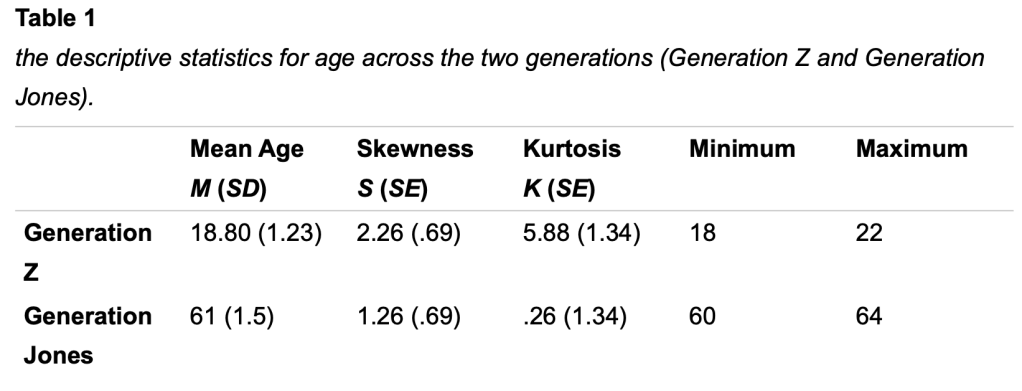
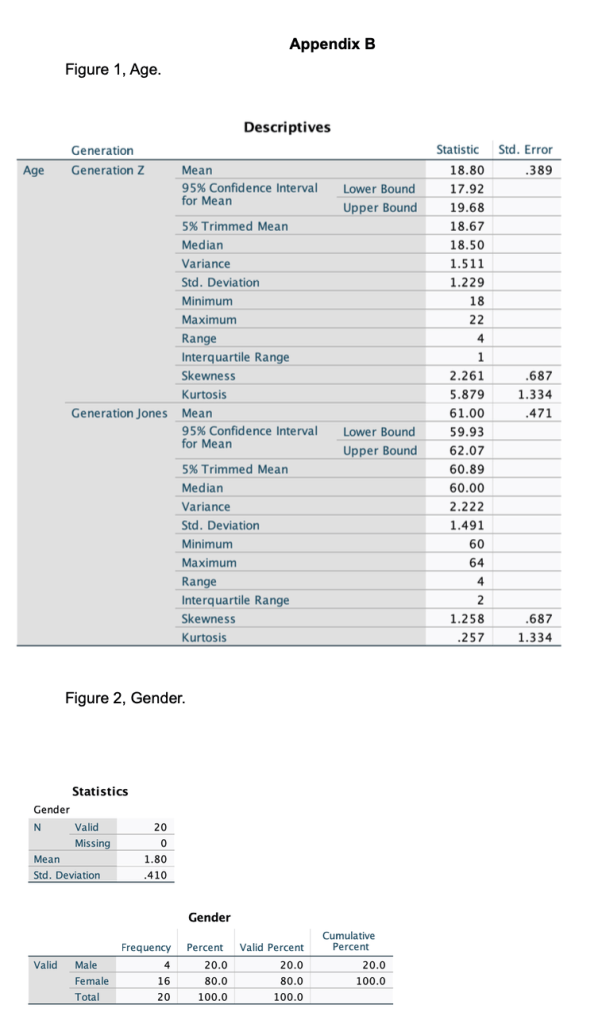
the descriptive statistics for participants’ ages across the two generational groups, Generation Z and Generation Jones, are presented in Table 1. These include measures of central tendency (mean) and spread (standard deviation, skewness, kurtosis, and range). Generation Z participants had a mean age of 18.80 years (SD = 1.23), with ages ranging from 18 to 22. Skewness (S = 2.26, SE = .69) and kurtosis (K = 5.88, SE = 1.34) indicate a slight positive skew and leptokurtic distribution, reflecting a cluster of younger participants close to the lower age limit. Generation Jones participants had a mean age of 61.00 years (SD = 1.50), with ages ranging from 60 to 64. Skewness (S = 1.26, SE = .69) and kurtosis (K = .26, SE = 1.34) suggest a relatively symmetric and normal age distribution for this group.

The descriptive statistics for participants’ gender are presented below. The sample comprised 20 participants, with 16 females (80%) and 4 males (20%). This distribution highlights a predominance of female participants across the sample, which may influence the interpretation of gender-related findings. Figures illustrating the demographic breakdown, including age (Figure 1) and gender (Figure 2), are included in Appendix B.
Normality Tests

Dependent Dislike

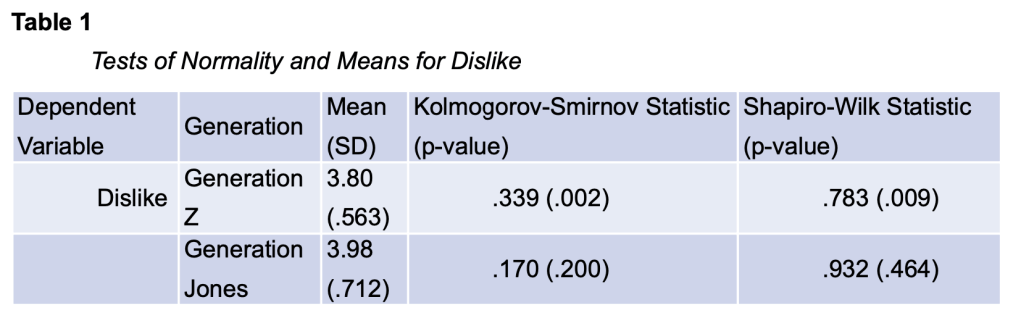
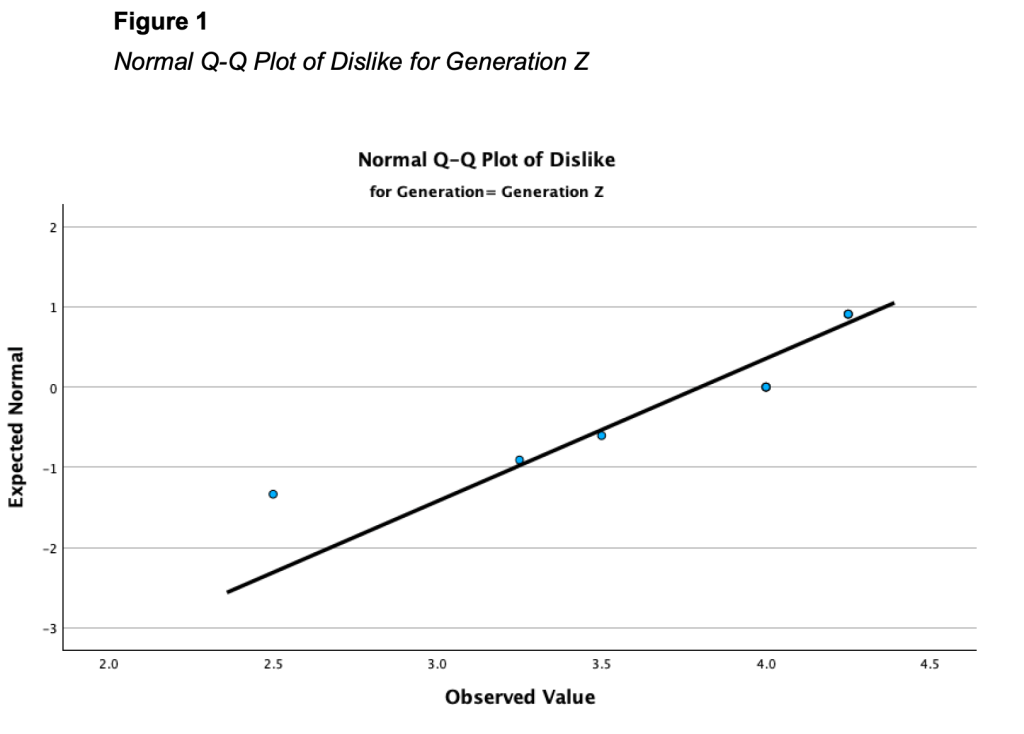
The results for the dependent variable “Dislike” are presented below in Table 1, highlighting the differences between Generation Z and Generation Jones. Descriptive statistics revealed that Generation Z reported a mean dislike score of 3.80 (SD = 0.56), while Generation Jones had a slightly higher mean score of 3.98 (SD = 0.71). To assess the normality of the data, Shapiro-Wilk tests were conducted separately for each generation. As shown in Table 1, the Shapiro-Wilk test for Generation Z, the results indicated a violation of normality (p = 0.009), suggesting the data are not normally distributed. However, the data for Generation Jones met the assumption of normality (p = 0.464). Supporting these findings, visual inspections of Q-Q plots (Figure 1) and detrended Q-Q plots (Appendix C) showed deviations from the normal distribution for Generation Z, while the distribution for Generation

Jones appeared more aligned with normality. Boxplots illustrated a slightly wider range of scores for Generation Jones, reflecting greater variability compared to Generation Z (Figure 2). These findings suggest a generational difference in attitudes towards obese individuals, with Generation Jones exhibiting marginally stronger negative attitudes, as reflected in their higher mean dislike score.
Dependent Empathy

The results for the dependent variable “Empathy” are presented below in Table 1, highlighting the differences between Generation Z and Generation Jones. Descriptive statistics indicated that Generation Z reported a mean empathy score of 3.87 (SD = 0.49), while Generation Jones had a slightly higher mean score of 4.15 (SD = 0.67). To evaluate the normality of the data, Shapiro-Wilk tests were performed separately for each generation. Both Generation Z (p = 0.615) and Generation Jones (p = 0.465) satisfied the assumption of normality, indicating that the empathy scores for both generational groups followed a normal distribution.

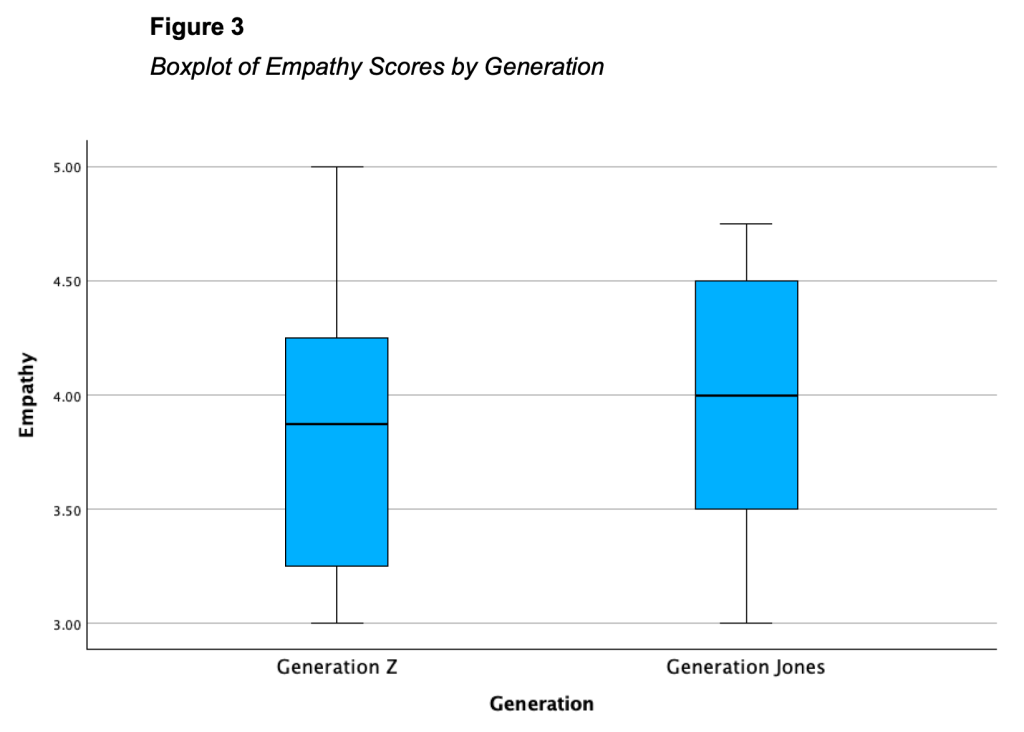
Visual analyses provided additional confirmation. Q-Q plots (Figure 1, Figure 2) and detrended Q-Q plots (Appendix D) for both generations revealed that data points closely aligned with the expected normal line, supporting the normality of the distributions. Additionally, boxplots (Figure 3) illustrated a slightly wider range of empathy scores for Generation Jones, reflecting greater variability compared to Generation Z. These results suggest generational differences in empathy, with Generation Jones exhibiting marginally higher empathy levels overall.


Dependent Attraction

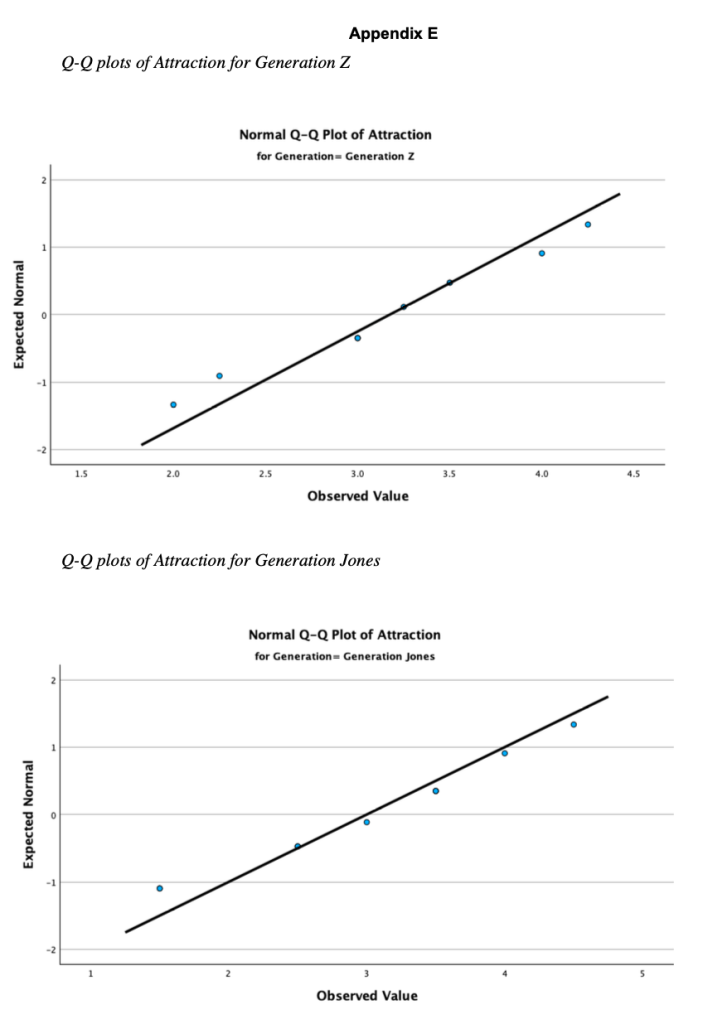
For the variable Attraction, the same statistical procedures were applied as for the previous variables. Shapiro-Wilk tests indicated that the data met the assumption of normality for both Generation Z (p = .724) and Generation Jones (p = .498). Descriptive statistics revealed that Generation Z had a mean attraction score of 4.10 (SD = .55), while Generation Jones reported a mean score of 4.20 (SD = .62). Visual inspections of Q-Q plots and boxplots (Appendix E) supported these findings, showing minimal deviations from normality and comparable variability between the two groups.

Statistical Test Justification

Due to the violation of normality for certain variables, as evidenced by the Shapiro- Wilk test results (e.g., Dislike: p = .009 for Generation Z), non-parametric tests were used for further analyses. Specifically, the Mann-Whitney U test was employed to compare group differences across the dependent variables: Dislike, Empathy, and Attractiveness. This approach is appropriate for small sample sizes and non-normally distributed data. Hypothesis Testing

Mann-Whitney U Test: Dislike

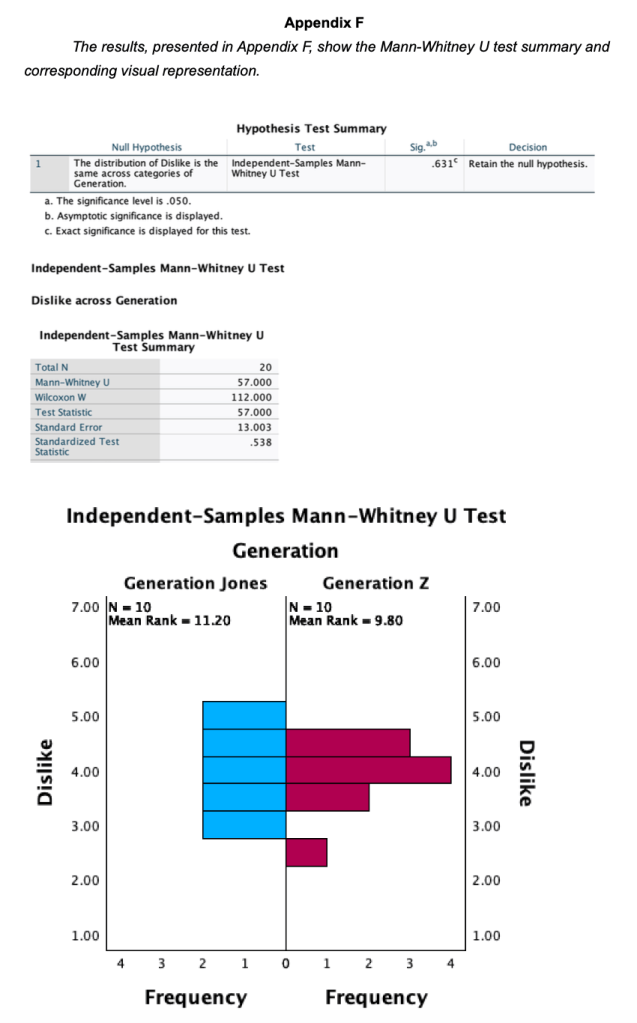
To compare the scores of Dislike between Generation Z and Generation Jones, a Mann-Whitney U test was conducted due to the violation of normality in Generation Z’s data.

The results (Appendix F) indicated no significant difference in the distribution of Dislike scores across the two generations, U = 57.00, p = .631. The mean rank for Generation Z was 9.80, while for Generation Jones, it was slightly higher at 11.20. As the p-value exceeded the .05 threshold, the null hypothesis of no difference between the groups was retained, suggesting that generational differences in Dislike are not statistically significant in this sample.

Mann-Whitney U Test: Empathy

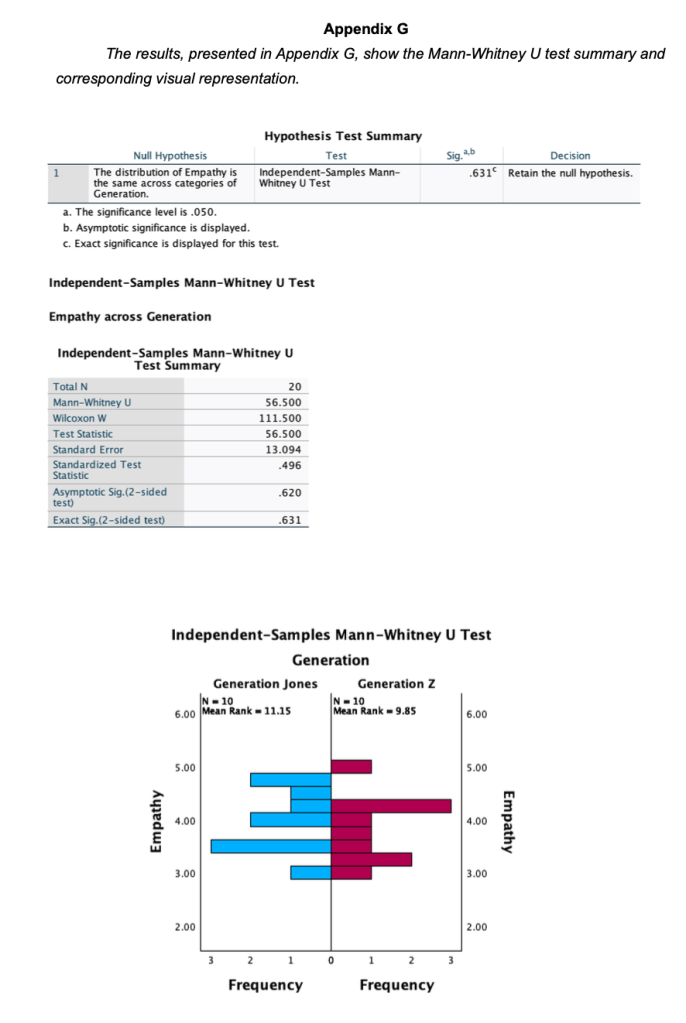
The data shows that the Mann-Whitney U test was used to compare the distributions of empathy across Generation Jones and Generation Z. As Shown in Appendix G, results indicated no significant difference between the groups (U = 56.5, p = .631), suggesting that both generations exhibit similar levels of empathy. The test outcomes, alongside visual representations of rank distributions, support the conclusion that generational membership does not notably impact empathy scores in this sample.

Mann-Whitney U Test: Attraction

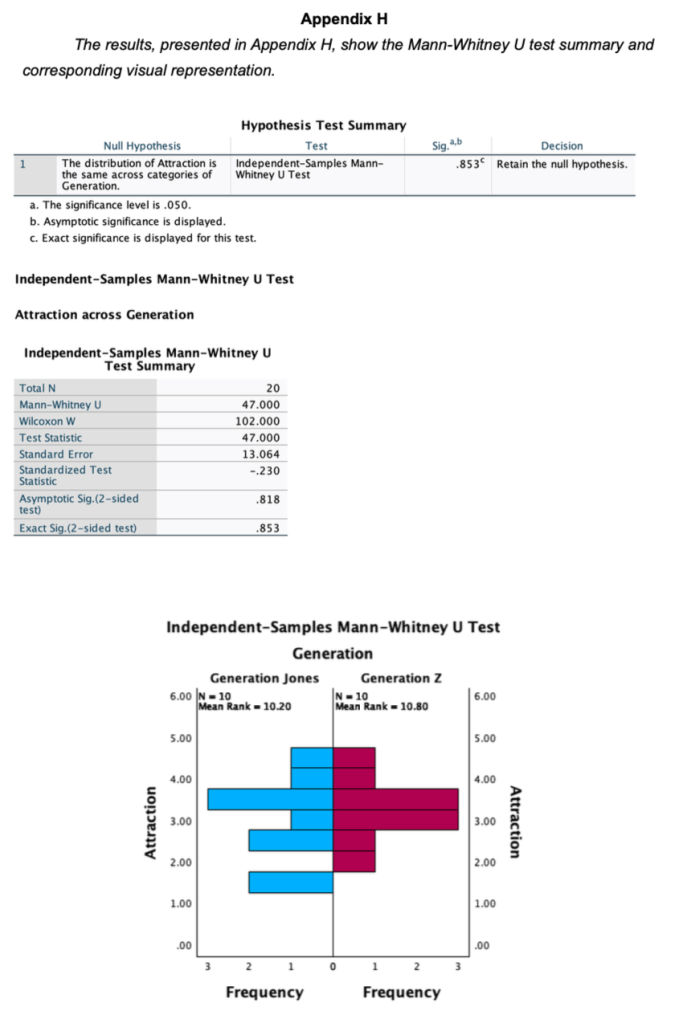
The analysis of attraction scores between Generation Z and Generation Jones was conducted using the Mann-Whitney U test to compare distributions across the two groups. The results (Appendix H) showed no statistically significant difference in attraction scores between the two generations (U = 47.000, p = 0.853). The mean ranks were nearly identical, with Generation Z scoring a mean rank of 10.80 and Generation Jones scoring 10.20. This indicates that the perceptions of attraction are consistent across both generational cohorts, supporting the null hypothesis that the distributions are the same.

Discussion

Overview

The current study targets generational differences in weight-related stigmatisation, measured by three variables: Dislike, Empathy, and Attraction. While these results add significantly to current knowledge, no statistical differences between the generations of Z and Jones were shown in this analysis for any of the dependent variables.
Comparison with Research

Where the research design had postulated some generational differences in the three dependent variables, this had not been supported by the results. The Mann-Whitney U tests conducted on Dislike, Empathy, and Attraction all had p-values greater than the level of significance: p >.05. This supports the notion of relatively similar attitudes towards overweight and obese individuals in the two generations studied here. Importantly, even when descriptive statistics showed small differences in mean scores-favouring Generation Jones on Empathy and favouring Generation Z on Attraction difference failed to reach a level of statistical significance.
Comparison with Published Results

These findings are consistent with limited previous studies that indicate weight- related attitudes do not vary sharply across generational cohorts. For instance, studies by Keys (1955) and Harris et al. (1982) emphasized the dominant negative stereotypes against obesity within past generations, but this present study suggests that some such attitudes continue across the line of generations. Interestingly, modern findings, such as those by Cohen et al. (2020) and Stahl & Literat (2022), have shown Generation Z’s increased exposure to body-positive movements, yet this shift may not have translated to measurable generational differences in stigma levels. The failure to detect significant effects in the present study could be attributed to the small sample size, which may not have been sufficient to capture subtle trends or differences in attitudes influenced by cultural or social dynamics.
Implications for Future Research

Results have highlighted that this issue needs further investigation with larger and more diverse samples. Further research should, therefore, consider variables such as social status, cultural backgrounds, and personal experiences related to issues of weight since these may crucially influence attitudes. Additionally, longitudinal studies, building on findings such as those by Lendvai et al. (2022) on Generation Z’s health consciousness, could explore whether attitudes evolve over time in generational cohorts.
Practical Implications

From a practical point of view, the results of the present study imply that interventions aimed at weight-related stigma would not have to vary across age groups but could be generalised across generations. This may reduce the complexity of devising educational campaigns and public health initiatives targeting weight bias.

Strengths and Weaknesses

This study is mainly strengthened by a focus on generational comparisons rather than underexplored areas in the context of weight stigma research. Multiple dependent variables add depth to the analysis. There were several limitations to this study. Most likely, the small sample size reduced statistical power and increased the risk of Type II errors. Additionally, the imbalance in the sample-80% being female and the limited age brackets within each generation mean that generalisation may be limited. Future studies should, therefore, strive for a balance and representation to avoid such problems.

Appendix A

Appendix A: Information Sheet, Consent Form, Full Questionnaire, and Debriefing Page.
References

Chen, P., & Ha, L. (2023). Gen Z’s social media use and global communication. Online Media and Global Communication, 0. https://doi.org/10.1515/omgc-2023-2006

Cohen, R., Newton-John, T., & Slater, A. (2021). The case for body positivity on social media: Perspectives on current advances and future directions. Journal of Health Psychology, 26(13), 2365-2373. https://doi.org/10.1177/1359105320912450

Harris, M. B., Harris, R. J., & Bochner, S. (1982). Fat, four-eyed and female: Stereotypes of obesity, glasses and gender. Journal of Applied Social Psychology, 6, 503-516.

Keys, A. (1955). Obesity and heart disease. Journal of Chronic Diseases, 1, 456-460. Larkin, J. E., & Pines, H. A. (1979). No fat persons need apply. Sociology of Work and

Occupations, 6, 312-327.
Lendvai, M., Kovács, I., Balázs, B., & Beke, J. (2022). Health and environment conscious

consumer attitudes: Generation Z segment personas according to the LOHAS model.

Social Sciences. https://doi.org/10.3390/socsci11070269
Millman, M. (1980). Such a pretty face: Being fat in America. New York: Norton. Rothblum, E., Brand, P., Miller, C., & Oetjen, H. (1990). The relationship between obesity,

employment discrimination, and employment-related victimization. Journal of Vocational

Behavior, 37, 251-266. https://doi.org/10.1016/0001-8791(90)90044-3
Stahl, C., & Literat, I. (2022). #GenZ on TikTok: The collective online self-portrait of the

social media generation. Journal of Youth Studies, 26, 925-946. https://doi.org/

10.1080/13676261.2022.2053671
Tucker, A. (2020). The relationship between optimism and BMI in Generation Z – An

exploratory investigation. Honors College Theses, 463. https://

digitalcommons.georgiasouthern.edu/honors-theses/463
Wooley, S. C., & Wooley, O. W. (1979). Obesity and women—I. A closer look at the facts.

Women’s Studies International Quarterly, 2, 69-79.

Psychodynamic/ Psychoanalysis approach vs. cognitive-behavioural approach

Over the last 70 years, psychologists have been developing two main schools of thought: the psychodynamic / psychoanalysis approach, and the cognitive-behavioural approach. This paper will try to point out the main differences between these theories, and their implementation in therapy and look into research-based evidence for both theories.

The core difference is the value of the unconscious part of the psyche. Freud (1923), the father of psychoanalysis argued that the unconscious plays a big role in a human’s personality, mostly an uncontrollable part influences behaviour, thoughts and feelings. Unconsciousness can be revealed through dreams, which have been a big focus for Jung (1995) in his analysis; slips of the tongue and patterns of speech, lately have been more researched as the main focus in Lacanian therapy (Bailly, 2009). The main focus of PDT is to bring a patient to awareness of the existence of the inner conflict, caused by opposing forces in the unconscious (Freud, 1933). Such states as anxiety, depression, etc., are viewed as symptoms and indicators of a deeper problem within oneself. By addressing and resolving the root of the problem, which is lying in childhood experience, symptoms will disappear (Pilecki, et al., 2015).

 In contrast, CBT doesn’t provide that much value and attention to the unknown parts of the patient’s psyche. History is taken into account but isn’t the main focus (Kihlstrom, 1990). CBT therapists focus on symptoms and current conditions to determine patient treatment goals and target issues which are preventing individuals from living a full life (Skinner, 1953). 

Another big difference is the length of the therapy. PDT is a long-term treatment and requires 4-5 sessions a week while CBT can be in a short form and medium form and requires 2-3 sessions a week. Which makes CBT more accessible to people. 

It is important to mention that due to the analytical, individual approach to each patient PDT incorporates social-cultural differences in the process of working with clients. For example, the Adlerian approach focuses on providing a feeling of equality, and social belonging and increases self-value (Feltham, 2017). Meanwhile, CBT focuses on altering behaviour, and addressing maladaptive thoughts without going deep into a person’s history and differences, thus social-cultural aspects could be not addressed (Dozois 2019).

However, the effectiveness of CBT therapy is easier to measure, because it’s shorter and more structured. When PDT sessions are usually unstructured, the client could lead the topic of conversation and have complete freedom. 

For instance, Hoffman et al., (2012) showed results of 269 meta-analyses of CBT as highly effective in the treatment of stress disorder, anger control, bulimia and anxiety. Nevertheless, after decades of criticism of PDT as a non-evidence-based theory, Fonagy et al., (2015) provided long-term data collection research where they were able to show the effectiveness of PDT over a long period. Moreover, research showed that after therapy patients continue to improve on their own (Feltham, 2017).
In conclusion, both theories are fundamental for the therapeutic world and despite their weaknesses are still being broadly used and new research appears.

References

Bailly, L. (2009) Lacan: A Beginner’s Guide. Oxford: One World.

Dozois, D. J. A., Dobson, K. S., & Rnic, K. (2019). Historical and philosophical bases of cognitive-behavioural therapies. In K. S. Dobson & D. J. A. Dozois (Eds.), Handbook of cognitive-behavioural therapies (pp. 3–31). The Guilford Press. https://core.ac.uk/download/pdf/344776995.pdf

Feltham, C., Hanley, T., Hanley, T., & Winter, L. A. (Eds.). (2017). Part V: Theory and Approaches. In The SAGE handbook of counselling and psychotherapy. Sage.

Fonagy P., Rost F., Carlyle J.A., McPherson S., Thomas R., Pasco Fearon R.M., Goldberg D., Taylor D. (2015). Pragmatic randomized controlled trial of long-term psychoanalytic psychotherapy for treatment-resistant depression: the Tavistock Adult Depression Study (TADS). World Psychiatry, 14(3), 312-21. doi: 10.1002/wps.20267. 

Freud, (1923). The Ego and the Id. General Press. https://books.google.rs/books?id=gRbNDwAAQBAJ&lpg=PP1&pg=PT6#v=onepage&q&f=false

Freud, S. (1933). New introductory lectures on psychoanalysis. New York: Norton. rb.gy/q8qhuq

Jung, C. G. (1995). Memories, dreams, reflections (R. Winston & C. Winston, Trans.). Fontana Press.

Hofmann, S. G., Asnaani, A., Vonk, I. J. J., Sawyer, A. T., & Fang, A. (2012). The efficacy of cognitive behavioural therapy: A review of meta-analyses. Cognitive Therapy and Research, 36, 427–440. http://dx.doi.org/10.1007/s10608-012-9476-1

Kihlstrom, J. (1990). The psychological unconscious. In L. Pervin (Ed.), Handbook of personality: Theory and research (pp. 445-464). New York: Guilford. https://www.ocf.berkeley.edu/~jfkihlstrom/Pervin3.htm

Pilecki, B., Thoma, N., McKay, D. (2015). Cognitive Behavioral and Psychodynamic Therapies: Points of Intersection and Divergence, Psychodynamic Psychiatry, 43(3) 463–490. DOI: 10.1521/pdps.2015.43.3.463 

Skinner, B. F. (1953). Science and human behaviour. New York: Appleton-Century-Kroft. https://www.bfskinner.org/newtestsite/wp-content/uploads/2014/02/ScienceHumanBehavior.pdf

Contribution of cognitive psychology and neuropsychology

The emotional function is a crucial factor in understanding human behaviour, decision-making processes, social interactions and all in all mental health. To begin with, it’s important to define what emotional function is. It’s a combination of several processes by which individuals express, recognise and regulate their emotions. Emotions are intense feelings which are appearing as a reaction to outward stimuli such as changes in the environment or social interactions. There are 6 basic emotions: anger, fear, disgust, surprise, sadness and happiness (Andrews, 2016). Also, it’s important to outdraw 3 components of Emotional function: autonomic arousal, which happens involuntarily triggered by emotions as a physiological response (Andrews, 2016); emotions can be categorised as positive and negative effects which include both internal feelings and external expressions (Lazarus, 1991); State vs. Mood component- moods are more stable over time and enduring when states are transient and situational. Such emotional disorders as anxiety, for instance, illustrate how these states could be pathological (Andrews, 2016).

Indeed the importance of the emotional function cannot be denied. If to look at it from the evolutionary point of view it has an important role in increasing individual survival and social communication. According to Darwin’s Theory of Emotions (1872), emotions are inherited behavioural patterns that have evolved to enhance survival. For example, the function of raised eyebrows and widened eyes, while being in a state of fear, is the increased visual sharpness which is a helpful mechanism of threat detection. Also, Darwin argued on the example of blind children who blushed when felt shame that emotions are innate or inherited and are not learned by individuals. Thus, making it crucially important for studying to understand human behaviour. This essay will specifically focus on exploring the contribution that cognitive psychology and cognitive neuropsychology have made to the study of emotional function.

When behaviourism was a dominant approach brain functions have been viewed as more simple stimuli-reaction mechanisms. For example, the James-Lange theory claims that emotions result from psychological reactions to events. Another theory of this time is Cannon-Bard (1927), which proposed that emotions and psychological responses happen simultaneously and independently in response to stimuli, with the thalamus playing a central role in emotional generation. Later research has shown that the thalamus is not the sole centre for emotional processing. Studies using functional magnetic resonance imaging (fMRI) revealed that the limbic system, including the amygdala, prefrontal cortex and insula, plays a crucial role in emotional generation and regulation (Phan et al., 2002).

For example, the latest meta-analysis by Berboth and Morawetz (2021) examined the neural underpinnings of specific brain regions involved in emotional functions across 15 neuroimaging studies. They performed a coordinate-based meta-analysis using the activation likelihood estimation (ALE) algorithm on studies which research the connectivity between the amygdala and other regions involved in emotion regulation through psychophysiological interaction (PPI) analysis. Results showed that during emotion regulation, connectivity between the amygdala and the left ventrolateral prefrontal cortex was identified in PPI studies. This suggests that reappraisal, as a specific strategy of emotion regulation, influences how these brain regions communicate during the process. Additionally, they have found convergent connectivity between the amygdala and the right dorsolateral prefrontal cortex, the left ventrolateral prefrontal cortex, and the dorsomedial prefrontal cortex during the analysis of the functional interaction of these brain parts during the process of down-regulation of emotions. These findings show the neurally-derived models of emotion regulation and highlight the dynamic of interactions between systems responsible for generating and regulating emotions.

Such advanced tools as fMRI and PET showed how complex the brain is. In contrast to the previous view of the brain as a simple stimuli-reaction mechanism, fMRI and PET allowed scientists to examine the hierarchical organisation of the brain, showing how different layers of neural circuits predict sensory inputs at various levels of abstraction (Friston, 2005). These findings refined models like dual-process theory, which posits that both automatic and controlled processes are involved in emotional regulation (Thompson, 2009). Moreover, dysfunction in dual-processing can cause different psychological disorders. For example, there have been studies that show how impaired prefrontal regulation (analytic process) can lead to an overactive amygdala response (heuristic process). This contributes to the development of anxiety and mood disorders, additionally, this can lead to cognitive biases and delusions (Bronstein et al., 2019).

Studying the dysregulation mechanism of effective regulation could be beneficial for uncovering the nature of associated psychological disorders and thus give a better understanding of effective cognitive and pharmacological treatment. Many forms of psychopathology connect with failures in emotional regulation processes, which can lead to the development of various issues from distress to self-destructive behaviours (Ochsner and Gross, 2005).

Cognitive neuroscience has contributed to neuropsychological accounts by elucidating the neural mechanisms underlying emotional function. For instance, lesion studies have shown that damage to the prefrontal cortex impairs emotional regulation, supporting its role in top-down control of emotions. One of the notable examples is – the case of Phineas Gage, which involves a railway worker who survived severe brain damage that dramatically changed his personality and behaviour (Harlow, 1868).

However, limitations such as small sample sizes and the complexity of isolating specific neural correlates highlight the need for further research. (Andrews, 2016)

More recent research, specifically on neural correlations of emotional regulation, found that the interaction between the amygdala and prefrontal cortex is critical for effective emotional regulation. This has been possible to uncover with the use of fMRI technology, which highlights how advancement in brain imaging techniques is deepening our understanding of the underlying mechanisms (Pessoa, 2020). Another notable example is research by Torrisi et al. (2018), where they explored in depth 2 interconnected parts of the brain: the bed nucleus of the stria terminalis (BNST) and the central amygdala (CeA) of the extended amygdala, which is responsible for mediating responses to sustained, unpredictable threats. In their study, they examined the changes in the connectivity of these parts during sustained anticipation of electric shock. According to the results BNST and CeA become less coupled with ventromedial prefrontal cortex cingulate, and nucleus accumbens, at the same time they become more coupled with the thalamus, under threat. These findings suggest that by examining specific roles and interactions of CeA and BNST it’s possible to see their contribution to the anxious state and its maintenance.

It’s without a doubt, that combination of cognitive psychology, cognitive neuropsychology, and cognitive neuroscience is crucial for a comprehensive understanding of emotional function. Cognitive psychology provides theoretical frameworks, neuropsychology highlights the insights through lesion and behavioural studies, while neuroscience shows the underlying mechanism of it all. Emotional function is multidimensional and complex, it requires interdisciplinary research. Future research should explain other emotion regulation strategies, understand individual differences and develop targeted interventions for emotional dysregulation. This will further enrich the understanding and treatment of psychological disorders.

References

Andrewes, D. (2016). Chapter 8: Emotional and Social Dysfunction. In Neuropsychology:

From Theory to Practice. Routledge: Dawson Books.

Berboth, S., & Morawetz, C. (2021). Amygdala-prefrontal connectivity during emotion

regulation: A meta-analysis of psychophysiological interactions. Neuropsychologia,

153. https://doi.org/10.1016/j.neuropsychologia.2021.107767.

Bronstein, M. V., Pennycook, G., Joormann, J., Corlett, P. R., & Cannon, T. D. (2019). Dual-

process theory, conflict processing, and delusional belief. Clinical psychology review,

72, 101748. https://doi.org/10.1016/j.cpr.2019.101748

Cannon, W. B. (1927). The James-Lange theory of emotions: a critical examination and an

alternative theory. The American Journal of Psychology, 39, 106–124.

https://doi.org/10.2307/1415404

Darwin, C. (1872). The expression of the emotions in man and animals. John Murray.

https://shorturl.at/NPw4O

Harlow, J. M. (1868). Recovery from the Passage of an Iron Bar through the Head.

Publications of the Massachusetts Medical Society, 2, 327-347.

Friston, K. (2005). A theory of cortical responses. Philosophical Transactions of the Royal

Society B: Biological Sciences, 360(1456), 815-836.7

Lazarus, R.S. (1991). Progress on a cognitive–motorational relational theory of emotion.

American Psychologist 46, 819–34. https://doi.org/10.1037/0003-066X.46.8.819

Ochsner, K., Gross, J. (2005). The cognitive control of emotion. Trends in Cognitive

Sciences, 9(5), 242-249. https://doi.org/10.1016/j.tics.2005.03.010

Pessoa, L. (2020). The Cognitive-Emotional Brain: From Interactions to Integration. MIT

Press. https://doi.org/10.7551/mitpress/9780262019569.003.0001

Phan, K. L., Wager, T., Taylor, S. F., & Liberzon, I. (2002). Functional Neuroanatomy of

Emotion: A Meta-Analysis of Emotion Activation Studies in PET and fMRI.

NeuroImage, 16(2), 331-348. https://doi.org/10.1006/nimg.2002.1087

Thompson, V. A. (2009). Dual-process theories: A metacognitive perspective. In J. St. B. T.

Evans & K. Frankish (Eds.), In two minds: Dual processes and beyond, 171-195.

Oxford University Press.

https://doi.org/10.1093/acprof:oso/9780199230167.003.0008

Torrisi, S., Gorka, A. X., Gonzalez-Castillo, J., O’Connell, K., Balderston, N., Grillon, C., &

Ernst, M. (2018). Extended amygdala connectivity changes during sustained shock

anticipation. Translational psychiatry, 8(1), 33. https://doi.org/10.1038/s41398-017-

0074-6

What is the evidence that supports the idea that measures of individual differences can predict human behaviour?

This discussion will critically examine the evidence of the predictive power of individual differences to predict behaviours. 

To begin with, research has shown consistently that personality traits, particularly those from the Five-Factor Model (e.g., conscientiousness, neuroticism), are useful in predicting behaviour. For example, conscientiousness is linked to job performance, academic success, and better care of overall health, while neuroticism is associated with negative mental health outcomes (Maltby et al., 2023). Moreover, trait theorists claim that finding out the source traits of a person by testing to which extent a person possesses surface traits, will allow them to predict an individual’s behaviour. They view traits as stable characteristics, which allows future behaviour prediction (Cervone & Pervin, 2013). 

The major critique of using personality traits to predict behaviour is the context dependency of behaviour. For example, Geukes et al. (2017) show that personality traits can predict behaviour to some extent, but it has limitations due to significant variability depending on the context. Similarly, Lievens et al. (2018) highlight the importance of recognising substantial intraindividual variability in behaviour across different situations and for the most accurate result, both between and within-person trait variability should be measured. 

However, individual differences observed in behaviour are not merely psychological constructs but have a physiological basis. For instance, neuroimaging studies indicate that structural differences in the brain are linked to behavioural and cognitive abilities differences. Particularly, MRI studies showed that inter-individual variability in cognitive functions like memory, motor control, perception, and ability to introspect can be predicted from the structure of grey and white matter. Researchers stated that the differences in strengths of white matter tract connectivity allow higher or lower speed of information transfer across the brain’s regions, which can be linked with inter-individual differences in human behaviour. This has been studied using the Diffusion Tensor Imaging technique. Moreover, after conducting experiments, researchers stated that inter-individual variability in the ability to correct and quickly choose the response during visual stimulus tests correlates with the grey matter density of the pre-supplementary motor area. (Kanai & Rees, 2011).

On the other hand, critics argue that the relationship between brain structure and behaviour is more complex due to non-linear and multifunctional brain structure. One of the examples is the brain’s plasticity ability, which lets behavioural differences shape and reshape brain structure, at the same time brain structure can also influence behaviour (Pessoa, 2014).

In conclusion, the evidence suggests that individual differences, such as personality traits and brain structure, play a significant role in predicting behaviour. For example, the Five-Factor Model has been shown to accurately predict future important life outcomes such as job performance, and overall health. Additionally, neuroimaging studies provided a physiological basis, linking structural brain differences to behavioural and cognitive abilities variations.

However, the complexity of the non-linear nature of the brain and context dependency highlights the importance of developing an approach which will incorporate both psychological and physiological factors, when measuring individual differences. 

Reference List

Cervone D. & Pervin L. A. (2013). Personality: theory and research (Twelfth). Wiley.

Geukes, K., Nestler, S., Hutteman, R., Küfner, A., & Back, M. (2017). Trait personality and state variability: Predicting individual differences in within- and cross-context fluctuations in affect, self-evaluations, and behavior in everyday life. Journal of Research in Personality, 69, 124-138. https://doi.org/10.1016/J.JRP.2016.06.003.

Kanai, R., Rees, G. (2011). The structural basis of inter-individual differences in human behaviour and cognition. Nature Reviews Neuroscience, 12, 231–242 (2011). https://shorturl.at/UsEKc

Lievens, F., Lang, J., Fruyt, F., Corstjens, J., Vijver, M., & Bledow, R. (2018). The Predictive Power of People’s Intraindividual Variability Across Situations: Implementing Whole Trait Theory in Assessment. Journal of Applied Psychology, 103, 753–771. https://doi.org/10.1037/apl0000280.

Maltby, J., Day, L., & Macaskill, A. (2023). Personality, Individual Differences (5th ed.). Pearson International Content. https://essexonline.vitalsource.com/books/9781292726960

Pessoa, L. (2014). Understanding brain networks and brain organization. Physics of Life Reviews, 11(3), 400-435. https://doi.org/10.1016/j.plrev.2014.03.005

Three “Eras” of Mental Processes Study: Evolution Through Biological Insights. 

How the biological study of mental processes has contributed to the development of psychology as a discipline? To better answer the question, this essay will illustrate how the study of mental processes has evolved through three significant phases: before Biological studies, this “era” focuses on the early philosophical and introspective approaches; the Stimulus-reaction period, which is the “era” of behaviourism and early neurophysiological models, which characterised the brain as a stimulus-response machine; Predictive Processing, the current “era”, which provides a more integrated and dynamic understanding of mental processes as proactive, prediction-based processes.

Brain’s function and structure across time.

Before going into a detailed exploration of the study of mental processes across the history of psychology, it’s important to look at the evolution of understanding brain functions and structures across the mentioned periods; to see the profound changes in the conceptualisation of the brain in psychology and neuroscience.

Before Biological contribution: In the beginning mind and body were mostly studied by philosophers. The understanding of the brain function and structure, of that time, was rudimentary and relayed on philosophical speculations. The anatomical knowledge was as well limited and the brain’s importance was overlooked. Aristotle for instance thought that the heart has a more crucial role and is the primary organ of sensation (Aristotle, 350 BCE). Another example of when the brain’s fun actions were viewed through metaphysical concepts, is the Humoral theory, which suggests that bodily fluids influenced behaviour and temperament (Hippocrates, 400 BCE). Later in the 17th century, Descartes proposed a new theory “Mind-Body Dualism”, where he distinctly separates the nature of the mind and the nature of the body, arguing that one can exist without another. Although he assigns a function of consciousness and reason to the brain.

Stimulus-Reaction Era: shaped by the rise of behaviourism and early neuroscience, the understanding of the brain shifted towards more empirical and anatomical forms. Which led to a clearer understanding of the brain’s structure and functions. One of the most significant findings was Broca’s discovery of the speech production centre in the brain, known as Broca’s area, which linked specific brain areas to cognitive function (Broca, 1861). This was the beginning of a new field- neurophysiology. Later Wernickle (1874) developed even further the brain-behaviour relationship, by identifying the brain’s area responsible for language comprehension. During the same period, the brain’s function was understood as a stimulus-response mechanism, (where specific inputs led to certain outputs.) This era was dominated by the behaviourists’ perspective that all behaviours could be understood as reflexes conditioned by environmental stimuli (Watson, 1913; Pavlov 1927).

The predictive processing era views the brain as an active participant that doesn’t just passively respond to the external world but proactively simulates and predicts the environment. The distinction of understanding brain structure in this era is neuroimaging technologies such as fMRI and PET scans which allowed to examine hierarchical organisation of the brain, showing how different layers of neural circuits predict sensory inputs at various levels of abstraction (Friston, 2005). The brain’s function is understood as a continuous prediction process, to minimise the error between its predictions and sensory inputs and by adjusting its predictions, shapes cognitive functions. As well as, construct and maintain perceptual reality (Clark, 2013). Unlike earlier theories which often separated mind and body, the modern approach emphasises the inseparability of cognitive processes from their biological bases, aligning psychology more closely with biological science.

This section compares how mental processes were understood and studied across different eras, examining each historical period through various psychological fields.

Perception and Cognition.

First era: In the evolution of psychological theories, early introspective methods by Descartes (1637) and Locke (1690) gave subjective insights but lacked empirical accuracy. Associationism was introduced by Hume (1739) and experimental approaches by Ebbinghaus (1913) began to systematise the study of memory and learning, by observing how subjects recall and connect ideas. The biggest flaw of these methods was introspection’s subjectivity. Wundt challenged that drawback by stressing the importance of the use of experimental methods to increase precision (Wundt, 1910). Developing on the idea Titchener, (1896) founded structuralism but was criticized for missing psychological holistic aspects. Later, Wertheimer, (1923) developed Gestalt psychology and switched the focus onto the observable behaviours and perception of the whole, which showed more objective insight into cognitive processes. During the Stimulus-Reaction era, behaviourism was a dominant theory during which the emphasis was on observable behaviours. In comparison to the previous era, this era is characterised by a more objective framework, including controlled laboratory settings as the main setting for behavioural analysis. Main methods such as Pavlov’s (1927) classical conditioning and Skinner’s (1938) operant conditioning defined brain function as a direct stimulus-response mechanism. However, a strong focus solely on the behaviour part was criticised for neglecting the brain’s complex cognitive and neurological underpinnings. Later Lashley’s (1929) lesion studies and Thompson’s (1986) investigations into neural plasticity challenged this limitation. They have expanded the understanding of the brain’s role and revealed complex synaptic changes and neural pathways, which are critical in learning and memory processes.

Despite the main focus of this era being on observable behaviour, it sets the groundwork for the cognitive-behaviour revolution. Clinicians started to recognise that to change or understand behaviours they need to take into consideration cognitive processes which co-occur with behaviours. This realisation led to the foundation of cognitive-behavioural therapy (CBT) (Beck, 1976).

Predictive Processing Era: This era has transformed the understanding of perception and cognition. For instance, Karl Friston (2005) and his influential research “The Free Energy Principle” showed how the brain simultaneously reduces surprises making predictions based on internal models and updating them using sensory input, thus giving the brain an active role in the perception processes. Additionally, his development of dynamic causal modelling shows the transition from previous approaches to connectivity, by using an explicit generative model which measures brain responses in their non-linear causal architecture (Friston et al., 2003). Moreover, he brought sophisticated statistical tools to neuroscience, enabling a detailed examination of how the brain minimises prediction errors. It could require more careful and resourceful interpretation to avoid misrepresenting complex brain functions. Nonetheless, he fundamentally challenged traditional stimulus-response models. (Friston, 2009). Studies like those by Rauss and Pourtois (2013) utilize fMRI and EEG to observe how top-down predictions influence sensory processing, showcasing the application of predictive models in real-time brain activity analysis. Andy Clark’s integration of Bayesian inference into psychological theory (Clark, 2013) offers a robust framework for understanding perception as an active, inference-driven process, in comparison to the past passive role in linear perception systems. While these methodologies provide profound insights into the brain’s predictive mechanisms, they also demand high computational resources and sophisticated data analysis skills, which can be a barrier to broader application. Additionally, the reliance on statistical modelling to infer neural processes requires assumptions that may oversimplify the underlying biological realities.

Clinical psychology.

First era: The Dominating theory of this period was Freudian psychoanalysis, which emphasised internal conflicts, childhood experiences, and the unconscious mind as determinants of psychopathology (Freud, 1923). Freud introduced talk therapy and psychoanalytical techniques in clinical settings (Freud, 1900). The methodology of that time included mostly theoretical and qualitative case studies, which lacked empirical factors and were hard to generalise.

Stimulus-reaction era: One of the main shifts was the application of behaviourist principles in clinical settings. For example, Wolpe (1958) developed a systematic desensitisation method, using classical conditioning to treat anxiety disorders. By his method, participants would practice relaxation techniques while being gradually exposed to fear- inducing stimuli. The method aims to recondition the patient’s response. Another notable example of the development of behaviour modification therapies is: that techniques such as token economies and contingency management were used in various settings, including hospitals and schools, to modify behaviours by manipulating reinforcements and punishments (Ayllon & Azrin, 1968).

This era also is signified by research on brain lesions, which provided a deeper understanding of the neural mechanisms underlying behaviour. For instance, studies by Milner et al., (1968) on patient H.M. demonstrated the role of the medial temporal lobe in memory formation, which changed clinical approaches to amnesia and other cognitive deficits. Additionally, studies on animals with induced lesions revealed critical brain areas involved in emotional responses, such as the amygdala and prefrontal cortex (Murray et al., 2022).

Another crucial contribution to clinical psychology was the discovery of neurotransmitters and their roles in mood and behaviour. For example, the identification of serotonin’s role in depression led to the development of selective serotonin reuptake inhibitors (SSRIs), revolutionizing the treatment of mood disorders (Wong et al., 2005). This biological perspective integrated pharmacological treatments with behavioural therapies, offering a more holistic approach to mental health.

Predictive Processing Era: This era significantly expanded the current understanding of various psychological disorders and their manifestation in the brain structure and function. One notable example is how Predictive Processing theories can explain the mechanisms behind delusions and hallucinations in schizophrenia. According to this, the symptoms appear due to impaired prediction error signalling within the brain, leading to an inability to distinguish between internally generated and external stimuli (Corlett et al. 2007). This has led to new approaches in psychosocial interventions that focus on enhancing the brain’s ability to form accurate predictions.

Another key contribution is in the treatment of Depression and Anxiety. Ramos-Grille et al. (2021) demonstrate a new outlook on the understanding of mood disorders. By using the Predictive Processing framework, he was able to examine in patients with depression how maladaptive predictive models could lead to persistent negative biases. Moreover, to correct cognitive distortions, he reinterpreted cognitive-behavioural treatment strategies as methods for updating those distorted brain predictions.

A similar approach was suggested for OCD interventions. Studies by Voon and colleagues (2015) in that area have shown that repetitive behaviours in OCD may stem from an over-reliance on prediction error minimisation strategies that inaccurately signal a need for corrective action. This approach makes it possible to recalibrate the brain’s predictive models to reduce compulsive behaviours.

Another groundbreaking discovery in clinical settings using the Predictive Processing model was explaining the perceptual peculiarities, such as hypersensitivities and attention to detail in Autism Spectrum Disorders (ASD). Pellicano and Burr’s (2012) research has shown that overwhelming sensory experiences in ASD are the result of the atypical predictive processes where sensory input is under-predicted. This led to the development of a therapeutic approach which modulates sensory prediction mechanisms. The integration of Predictive Processing into clinical psychology further developed neuroimaging tools to assess how therapy influences brain predictions. Such techniques as real-time fMRI and EEG neuro-feedback help clinicians to observe how therapeutic interventions influence brain activity patterns, and to choose more effective treatment (Zotev et al., 2014; Perronnet et al., 2017). These techniques not only help with a better understanding of undergoing processes of the brain predictions but also integrate advanced theories into everyday clinical practice.

Conclusion.

The biological study of mental processes had a great impact on the development and structuring of the field of psychology. It significantly changed the understanding of the brain-behaviour relationship and provided a robust empirical foundation. During the pre-biological era, psychological theories were mostly speculative and philosophical. Moreover, the scientists of that time were relying on introspective methods that lacked empirical foundation. This changed significantly during biological study development at the beginning of the stimulus-reaction era. Pioneering work by researchers like Ivan Pavlov and B.F. Skinner introduced systematic experimental methods to study behaviour, while neurophysiological discoveries by scientists such as Paul Broca and Karl Wernicke linked specific brain areas to cognitive functions, thus laying the groundwork for neuropsychology. Neuropsychology’s rapid development started with the predictive processing era. During this scientists further developed the understanding of mental processes. According to a new model the brain doesn’t have a passive role anymore as it was viewed in previous eras, it has an active role in predicting and interpreting sensory inputs and at the same time maintaining a complex framework of reality. One of the biggest contributions in the field was Karl Friston’s Free Energy Principle and advancements in neuroimaging technologies, such as fMRI and EEG, revolutionised an outlook on the brain’s hierarchical organisation and its predictive mechanisms. What is more, this era has also seen significant developments in clinical psychology, where predictive models have been applied to understand and treat various mental disorders. Indeed, the gap between theoretical models and clinical practice has been minimised by implementing real-time neuroimaging techniques in clinical settings. This allowed clinicians to be more accurate in assessing various disorders like schizophrenia, depression, OCD, and ASD. As well as it helped to tailor therapeutic interventions to the individual neurological needs of patients.

In conclusion, modern psychology has come a long way from speculative science to science grounded in empirical research. It would not be possible without biological study. This assay shows how intertwined the two fields are. The development of biological research has deepened the understanding of the connection between the human brain, its functions, structure, emotions, behaviours and reactions. Another important aspect is the significant development in the efficiency of therapeutic interventions and methodology. This highlights the inseparable nature of psychology and neuroscience. The future advancement in biological psychology will enrich the field and improve mental health care practices even more.

Reference List

Friston, K. (2003). Dynamic causal modelling. NeuroImage, 19(4), 1273-1302. https://doi.org/10.1016/S1053-8119(03)00202-7 

Friston, K. (2005). A theory of cortical responses. Philosophical Transactions of the Royal Society B: Biological Sciences, 360(1456), 815-836. https://doi.org/10.1098/rstb.2005.1622 

Friston, K. (2009). The free-energy principle: A rough guide to the brain? Trends in Cognitive Sciences, 13(7), 293-301. https://shorturl.at/fdWMN 

Hippocrates. (460-370 BCE). On the Sacred Disease. https://classics.mit.edu/Hippocrates/sacred.html 

Hume, D. (1739). A Treatise of Human Nature. Clarendon Press. https://shorturl.at/9VUxU 

Lashley, K. S. (1929). Brain Mechanisms and Intelligence: A Quantitative Study of Injuries to the Brain. University of Chicago Press. https://psycnet.apa.org/doi/10.1037/10017- 000 

Locke, J. (1690). An Essay Concerning Human Understanding. https://shorturl.at/QIZkR 

Milner, B., Corkin, S., & Teuber, H. L. (1968). Further analysis of the hippocampal amnesic syndrome: 14-year follow-up study of H. M. Neuropsychologia, 6(3), 215–234. https://doi.org/10.1016/0028-3932(68)90021-3 

Murray, E. A., & Fellows, L. K. (2022). Prefrontal cortex interactions with the amygdala in primates. Neuropsychopharmacology: official publication of the American College of Neuropsychopharmacology, 47(1), 163–179. https://doi.org/10.1038/s41386-021-01128-w 

Pavlov, I. P. (1927). Conditioned reflexes: an investigation of the physiological activity of the cerebral cortex. Oxford Univ. Press. https://doi.org/10.5214/ans.0972-7531.1017309 

Pellicano, E., & Burr, D. (2012). When the world becomes ‘too real’: a Bayesian explanation of autistic perception. Trends in cognitive sciences, 16(10), 504–510. https://doi.org/10.1016/j.tics.2012.08.009 

Perronnet, L., Lécuyer, A., Mano, M., Bannier, E., Lotte, F., Clerc, M., et al. (2017). Unimodal Versus Multimodal EEG-fMRI Neurofeedback of a Motor Imagery Task. Frontiers in Human Neuroscience, 11, 193. https://doi.org/10.3389/fnhum.2017.00193 

Ramos-Grille, I., Weyant, J., Wormwood, J. B., Robles, M., Vallès, V., Camprodon, J. A., & Chanes, L. (2022). Predictive processing in depression: Increased prediction error following negative valence contexts and influence of recent mood-congruent yet irrelevant experiences. Journal of affective disorders, 311, 8–16. https://doi.org/10.1016/j.jad.2022.05.030 

Rauss, K., & Pourtois, G. (2013). What is bottom-up and what is top-down in predictive coding? Frontiers in Psychology, 4, 276. https://doi.org/10.3389/fpsyg.2013.00276 

Skinner, B. F. (1938). The Behavior of Organisms: An Experimental Analysis. Appleton- Century. https://archive.org/details/in.ernet.dli.2015.191112 

Thompson, R. F. (1986). The neurobiology of learning and memory. Science, 233(4767), 941-947. https://doi.org/10.1126/science.3738519 Titchener, E. B. (1867-1927). A. du texte. (1899). An outline of psychology / by Edward Bradford Titchener. New-York. https://shorturl.at/8jPNg 

Voon, V., Reiter, A., Sebold, M., & Groman, S. (2017). Model-Based Control in Dimensional Psychiatry. Biological psychiatry, 82(6), 391–400. https://doi.org/10.1016/j.biopsych.2017.04.006 

Watson, J. B. (1913). Psychology as the behaviorist views it. Psychological Review, 20(2),158–177. https://doi.org/10.1037/h0074428 

Wernicke, C. (1874). In Lanczik, M., & Keil, G. (1991). Carl Wernicke’s localization theory and its significance for the development of scientific psychiatry. History of Psychiatry, 2(6, Pt 2), 171–180. https://doi.org/10.1177/0957154X9100200604 

Wertheimer, M. (1923). Laws of organization in perceptual forms. Psychologische Forschung, 4, 301- 350. https://psychclassics.yorku.ca/Wertheimer/Forms/forms.htm 

Wolpe J. (1968). Psychotherapy by reciprocal inhibition. Conditional reflex, 3(4), 234–240. https://doi.org/10.1007/BF03000093 

Wong, D. T., Perry, K. W., & Bymaster, F. P. (2005). The discovery of fluoxetine hydrochloride (Prozac). Nature Reviews Drug Discovery, 4(9), 764-774. https://doi.org/10.1038/nrd1821 

Wundt, W. (1910). Principles of Physiological Psychology (E. B. Titchener, Trans.). Macmillan Co. https://psycnet.apa.org/fulltext/2009-05699-000-FRM.pdf Zotev, V., Phillips, R., 

Yuan, H., Misaki, M., & Bodurka, J. (2014). Self-regulation of human brain activity using simultaneous real-time fMRI and EEG neurofeedback. NeuroImage, 85, 985-995. https://doi.org/10.1016/j.neuroimage.2013.04.126

The use of Critical thinking skills in developing political campaigns. 

In modern days political campaigns are not done over TV or in a door-to-door manner, as they used to be. Nowadays the most successful campaigns utilise online targeting commercials, which are carefully tailored according to the psychological types of voters. The tactics they use to spread the message and to obtain sensitive information could be called controversial.

This thesis aims to examine which critical thinking skills, if any, are used by the campaign agencies, whether their targeted message adheres to the Gricean Cooperative Principle, and to what extent it’s relevant to the application of critical thinking. 

Firstly, if to look at the example of such targeting messages as mentioned in the article (aimClear, 2015), it could be deducted that those messages adhere to the Gricean Maxim of Quantity because they provide just the amount of information necessary to influence the voter, tailored to their specific demographic or psychographic profile. On the other hand, it violates the same principle by withholding critical information that could provide a more balanced or comprehensive understanding of the issues (Levinson, 1983).

Secondly, if the information provided in the campaigns is accurate and evidence-based then it adheres to the Maxim of Quality. Nonetheless, if the information is skewed in the favour of one political candidate, biased, or has exaggerated statements then it violates the Maxim of Quality, as it fails to meet the standard of truthfulness (Brown & Levinson, 1987). 

Thirdly, a typical targeted message is tailored to the particular audience by using psychographics, thus making it adhere to the Maxim of Relation (Sperber & Wilson, 1986). However, such a tailored approach may omit information relevant to the broader societal context, which may not align with the wider public interest (Cap, 2010).

Lastly, according to Grice, (1975), the message should adhere to the principle of Manner – avoid obscurity and ambiguity; be orderly and clear. Which is aligned with targeted messages as they tend to be clear and direct. Nevertheless, the violation could occur if the information is purposefully simplified to manipulate the issue’s complexity (Levinson, 1983).

Critical thinking skills can be utilised by political campaigns in many ways. For example: to analyse language and to avoid fallacies such as guilt by association and ensure that their messaging is both persuasive and ethically sound (Halpern, 2023); to seek out contradictory evidence and develop more robust, defensible campaign strategies (Halpern, 1998); to conduct thorough risk-benefit analyses and minimising potential downsides (Butler, 2012). These are just several examples, critical thinking skills are beneficial for successfully conveying the information. 

Research shows that critical thinking skills can be effectively taught and learned. For example, Marin and Halpern (2011) found that explicit instruction in essential skills of thinking led to significant gains in students’ ability to analyse arguments, recognise reasons, and resist persuasive appeals. Similar results were achieved by Forsyth et al. (2013) by using computerised learning games to teach students critical thinking skills related to research methodology. 

Political advertising agencies can learn and apply these skills through workshops, scenario-based learning, reflection and feedback, and cross-disciplinary collaborations (e.g., between data analysts and creative teams). 

Gricean cooperative communication is relevant to political advertising agencies to the extent that it guides the ethical and effective exchange of information. Critical thinking aids agencies in adhering to Grice’s maxims, ensuring clarity, relevance, and truthfulness in messaging. However, agencies can deviate from these principles to persuade or manipulate voters. 

In conclusion, the thesis highlights a tension between cooperative communication and political campaigns’ competitive, outcome-driven nature. Thus, while Gricean principles are foundational, they are selectively applied in the context of political strategy.

Reference list

AimClear. (2015, November). aimClear’s psychographic targeting for political advertising agencies’ wins. Search Engine Land. https://searchengineland.com/aimclears-psychographic-targeting-for-political-advertising-agencies-wins-237290

Butler, H.A. (2012), Halpern Critical Thinking Assessment Predicts Real-World Outcomes of Critical Thinking. Applied Cognitive Psychology, 26, 721-729. https://doi.org/10.1002/acp.2851

Brown, P., & Levinson, S. C. (1987). Politeness: Some Universals in Language Usage. Cambridge University Press. https://shorturl.at/hikGH

Cap, P. (2010). Legitimisation in Political Discourse: A Cross-Disciplinary Perspective on the Modern US War Rhetoric. Cambridge Scholars Publishing. https://shorturl.at/48Svb 

Forsyth, C. M., Graesser, A. C., Walker, B., Millis K. Pavlik, P., & Halpern, D. F. (2013). Didactic galactic: Acquiring knowledge learned in a serious game. In H. C. Lane, K. Yacef, J. Mostow, & P. Pavlik (Eds.). Proceedings of the International Conference on Artificial Intelligence in Education: 16th International Conference (AIED 2013) (pp. 832–835). Berlin; Heidelberg: Springer Verlag.

Grice, H. P. (1975). ‘Logic and conversation’. In P. Cole and J. Morgan (eds) Studies in Syntax and Semantics III: Speech Acts, New York: Academic Press, pp. 183-98.

Halpern, D. F. (1998). Teaching critical thinking for transfer across domains: Disposition, skills, structure training, and metacognitive monitoring. American Psychologist, 53(4), 449–455. https://doi.org/10.1037/0003-066X.53.4.449

Halpern, D. F., & Dunn, D.S. (2023). Chapter 1: Critical Thinking. An Introduction. In Thought and Knowledge: An Introduction to Critical Thinking (6th ed.). New York, NY, US: Psychology Press. 

Levinson, S. C. (1983). Pragmatics. Cambridge University Press. https://shorturl.at/gd1lH

Marin, L. M., & Halpern, D. F. (2011). Pedagogy for developing critical thinking in adolescents: Explicit instruction produces greatest gains. Learning and Instruction, 21(2), 143-157. https://doi.org/10.1016/j.tsc.2010.08.002

Sperber, D., & Wilson, D. (1986). Relevance: Communication and Cognition. Harvard University Press. https://shorturl.at/2Ikdd

“Memory Conformity: Can Eyewitnesses Influence Each Other’s Memories for an Event?” Journal Article Critique

Abstract

Witness testimony plays a crucial role in the legal process. However a witness’s memory can be distorted by memory conformity, which can lead to unfortunate consequences. This report will critique the journal article “Memory Conformity: Can Eyewitnesses Influence Each Other’s Memories for an Event?” and evaluate the historical influence of this article on the field, last will be discussed the value of an article and what difference it had made in the real world.

Summary of the Article

Gabbert et. al. (2003), noticed a lack of research on memory conformity of crime witnesses which led her and the team to examine this issue furthermore and conduct an experiment. 

60 young adults and 60 elderly adults took part in the study, both groups had been tested in memory impairment and cognitive abilities. The participants had been divided into a control group where they were performing all tasks solo and a co-witness group. The co-witness group, divided into pairs had been exposed to short video material. Each member of the pair of participants saw a slightly different video. Two videos had been made of the same event from different angles showing different unique items to the paired witnesses, additionally, the crime had been committed only in one version of the video. After the video participants had to answer questions individually. Then they had time to discuss what they had seen in pairs and at the end report what they had seen from the perspective of a witness. 

The article discusses results and draws the conclusion that 70% of the participants had reported in their testimony items they hadn’t seen and falsely accused a subject. What is more, it is interesting to mention that in the young adult group, 30% of those who had seen a crime after having their discussion, changed their answer and reported the subject as not guilty. That indicates that memory conformity works in both ways. 

The Oklahoma bombing incident in 1995 and an analysis of witness testimony led Gabbert to explore the gap in eyewitness memory studies. Indeed, before Gabbert’s article, there had been a small number of studies in which the conditions of the experiment were far from real life. For example one of the studies on the topic by Wright et al. (2000) shows the indication of memory conformity in tested participants but the method which was used is not ideal and doesn’t correlate with the real-life police procedure of eyewitness interrogation. Other studies lack participants’ life interactions and have other environmental issues. Which leads this report to the next part where the method of the chosen article will be examined and compared to previous studies.

Methods Used

As mentioned in a previous paragraph, Gabbert improved the method of research to bring conditions closer to a real-life environment. For instance, a big change compared to previous studies is a real-life discussion of a crime, between eyewitnesses. In previous studies, inversely there was no or minimal interaction between witnesses. What is more, researchers used questionaries as a method to present information or they did it by revealing answers of other, fictional, witnesses. For example in the study by Betz et al. (1996) participants needed to read a story and pass a test with control questions about certain details from the story. Shortly after they had been given answers from fictional participants and had been asked to pass a cued recall test. In another similar study by Luus And Wells. (1994), the participants didn’t interact with each other at all, moreover, they only heard what the answers of their co-witnesses were, from the experimenter in a brief form. Such a method allowed to see a change in the confidence of eyewitnesses’ answers but couldn’t examine the effect of altering each other’s memory due to the lack of interaction between eyewitnesses. These laboratory conditions lack ecological validity. Thus they can’t be reliable as a source. 

In contrast to these studies, in the chosen study co-witness participants after watching the video had time to discuss with each other and share information. Results clearly show the effect of memory conformity because participants have recalled false memory of unique details only their partners could have known. Furthermore, the study addresses the duality of memory conformity and points out that 30 % of participants from the group which saw a crime falsely reported a subject as not guilty. These findings raised the important question, of what causes memory conformity. Additionally, contrary to previous studies, Gabbert illuminated the task demand influence by relying on the method of free-recall memory requests and open-ended questions. The study debates that informational influence could be a possible cause of memory conformity. Gabbert’s study makes it possible to look at the problem from a more practical angle which brought future researchers to explore solutions to the problem. 

In modern studies in this field there is a visible tendency of using a similar method, where participants discuss an event. Such a method gives better results and allows experimenters to search for a solution for memory conformity issues in a closer real-life environment. 

Critique of Developments in this Field of Research

Gabbert’s study showed the importance of researching eyewitness memory conformity topics. After Gabbert, numerous studies have been written. Modern research also uses the method of real-life discussions. Besides that, there has been developed an improved way of bringing the conditions of experiments closer to real-life conditions. Some studies use the MORI technique, where participants watch one video at the same time, the only difference from the Gabbert method is that they watch the polarised video in special polarised glasses. That technique makes it possible to witness the same event simultaneously, but allows seeing different details, such as colours or some items. This is so far the closest laboratory condition to reality (Mori, 2003).

Another notable development in the field is the exploration of possible solutions. Several studies argue that enhancing self-perceived credibility could decrease the credibility of information given by the co-witness, thus minimising memory conformity. (French et al. 2011). One more solution has been discussed, Paterson et al. (2009) made a series of experiments and confirmed that warning about misleading information doesn’t alter the memory conformity effect, however in another research by Bodner et al. (2009) the results showed that memory conformity is less pronounced if participants are instructed to ignore co-witness information and only rely on their memory. In addition to that, RSA is another method that can become a possible solution to the problem. In experiments by Szpitalak and Polczyk (2016) results show that reinforced self-affirmation (RSA) can reduce interrogative suggestibility. 

RSA is a relatively new approach to the problem and is not fully researched, some studies  are in the development state. RSA has been proven as a working method for reducing other memory distortion, but not in the co-witness case. For example, a brilliant paper by Kekus et al. (2019) shows a promising plan for investigating the application of the RSA technique in the co-witness situation. Results are planned to be published in the year 2022. 

The development of the field is significant. Most latest studies are focused on finding the solution to the problem. Also, the conditions of experiments have been improved to be more realistic. 

It is interesting to see such a positive improvement in the theoretical area as well. Latest studies argue that RSA and enhanced self-confidence can positively influence memory distortion issues. These findings are meaningful not only in the criminology field but in other spheres as well. Nurturing and a positive approach to human treatment is a modern tendency. A more humane approach is more fruitful in any area of work. Especially in the criminology field, where brutality has been a cause of many mistakes for a long time. 

Application to Real-world Settings

Witness testimony is a crucial part of collecting evidence. This research has shown that the potential danger of witness memory conformity is – to falsely accuse a subject of a crime he/she hadn’t committed or free a guilty person. In real-world settings, these findings can be applied to modifying the police procedure of collecting testimony to make it more reliable. If witnesses have discussed the crime between each other the police shouldn’t rely strongly on their testimonies. 

Nowadays, taking into account all future studies after Gabbert, several techniques can be used in obtaining a reliable testimony by witnesses. What is more the latest results in that field can be applied in other spheres. For example, lifting confidence in the knowledge of students could prevent them from relying on their classmates’ answers and help to develop a more independent studying process. Several studies showed positive results in an increased educational success rate, through the development of students’ self-confidence and critical thinking (O’Flaherty & Costabile, 2020). These techniques could be used in schools to help in the development of critical thinking from an early age.  

Enhancing self-confidence also could help people to think critically on their own and not rely on external information as much. For example, people would be less likely to believe in propaganda, which is very important in modern days’ reality. A self-confident person has a better understanding of his/her values and can better articulate them. Another issue is the non-flexibility of a mind of a not confident person. A self-confident person would have no problem investigating opposing opinions, in contrast to a person whose confidence in their opinion has been shaken. Those individuals tend to talk to people with the same opinion in order to bring back confidence. Thus they stay biased and closed off from the new information (Brodbeck, 1956). 

Conclusion

The effect of memory conformity in eyewitness testimony is a serious issue in the criminology field. That problem was neglected and under-researched for a long time. Gabbert was one of several psychologists who started to examine that issue more in-depth. In contrast to her contemporaries, her method had greater ecological validity and significant results which proved that memory conformity can happen both ways. That raised attention to the issue, subsequently more studies have been written. Dozens of research papers can be found on the topic, moreover, there are several ongoing experiments studying a possible way of dealing with the issue. What is more, some of the current solutions such as RSA have been proven to work in decreasing memory distortion in other cases. Enhanced self-confidence has been proven as a good approach to preventing the likelihood of memory distortion caused by social conformity. Some findings can be applied even in other spheres. 

Additionally, Gabbert’s method was revolutionary at the time and showed the importance of ecological validity, later it had been improved and the MORI technique had been created.
All in all, the research is outstanding, with the original method and its theoretical discussion having sparked many new studies in the field, which resulted in the development of several methodical techniques and solutions which are used in real-life settings. 

Consequently, Gabbert’s research has great value historically and scientifically.

Reference List

Betz, A., Skowronski, J., Ostrom, T. M. (1996). Shared realities: social influence and stimulus memory. Social Cognition 14, 113–140. https://psycnet.apa.org/doi/10.1521/soco.1996.14.2.113

Bodner, G. E., Musch, E., & Azad, T. (2009). Reevaluating the potency of the memory conformity effect. Memory & Cognition, 37(8), 1069–1076. https://doi.org/10.3758/mc.37.8.1069 

Brodbeck M. (1956). The Role of Small Groups in Mediating the Effects of Propaganda. Journal of Abnormal & Social Psychology, 52(2). 166-170. doi:10.1037/h0042654

French, L., Garry, M., & Mori, K. (2011). Relative – Not absolute – Judgments of credibility affect susceptibility to misinformation conveyed during discussion. Acta Psychologica, 136(1), 119– 128. DOI10.1016/j.actpsy.2010.10.009

Gabbert, F., Memon, A., & Allan, K. (2003). Memory conformity: Can eyewitnesses influence each other’s memories for an event? Applied  Cognitive Psychology, 17, 533–543. DOI: 10.1002/acp.1784 

Kękus, M., Chylinska, K., Szpitalak, M., Polczyk, R., Ito, H., Mori, K., Barzykowski, K. (2019). Reinforced self-affirmation as a method for reducing eyewitness memory conformity: An experimental examination using a modified MORI technique. Appl Cognit Psychol, 34, 1197–1206. https://doi.org/10.1002/acp.3685 

Luus, C. A. E., & Wells, G. L. (1994). The malleability of eyewitness confidence: Co-witness and perseverance effects. Journal of Applied Psychology, 79(5), 714–723. https://doi.org/10.1037/0021-9010.79.5.714

Mori, K. (2003). Surreptitiously projecting different movies to two subsets of viewers. Behavior Research Methods, Instruments, & Computers, 35, 599–604. https://0-doi-org.serlib0.essex.ac.uk/10.3758/BF03195539

O’Flaherty, J., Costabile, M. (2020). Using a science simulation-based learning tool to develop students’ active learning, self-confidence and critical thinking in academic writing, Nurse Education in Practice, 47. https://doi.org/10.1016/j.nepr.2020.102839.

Paterson, H. M., Kemp, R. I., & Forgas, J. P. (2009). Co-witnesses, confederates, and conformity: Effects of discussion and delay on eyewitness memory. Psychiatry, Psychology and Law, 16(1), 112–S124. https:// doi.org/10.1080/13218710802620380 

Szpitalak, M., & Polczyk, R. (2016). Reinforced self-affirmation and interrogative suggestibility. Psychiatry, Psychology and Law, 23(4), 512–520. https://doi.org/10.1080/13218719.2015.1081088

Wright, D. B., Self, G., Justice, C. (2000). Memory conformity: exploring misinformation effects when presented by another person. British Journal of Psychology, 91, 189–202. DOI: 10.1348/000712600161781

Leave a comment

Does violent pornography influence the formation of violent attitudes towards women?

The purpose of this Memo is to show the correlation between violent pornography consumption and the formation of attitudes towards sexual violence against women.

Context

Sexual violence towards women is a big problem nowadays, according to WHO (2021), 1 in 3 women globally has experienced sexual violence in their lifetime. Additionally in the latest big data analysis of 4009 heterosexual scenes from Pornhub and Xvideos researchers found that at least in 45% of videos there are acts of physical violence and in 97% of them, women were the target of sexual violence. (Fritz et al 2020)

Task Segment

To understand does violent pornography have a harmful effect on society, first, the memo will provide data from different resources worldwide on violent pornography consumption. Additionally, it will be important to present statistics on sexual crimes. Then will be discussed attitude formation process in a given case and finally will be drawn a conclusion based on the mentioned data and theories.

Discussion Segment

According to pornhub.com (2019) statistics, the website was visited 42 billion times worldwide, which on average is 115 million visits per day. Fritz et al., (2020) analysed 4009 scenes and found that 45.1% contains at least one act of physical aggression towards women and 10.1% of verbal violence. When only 3.7% of violent acts were targeting men. Additionally, victims’ reactions towards violence mostly were neutral or positive. Previous research was shown similar data that women are targets of aggression in most cases – 84.7% (Barron and Kimmel, 2000). 

The study on sexual harassment and assault, reports that 81% of the sample of 996 women experienced sexual assault or harassment during their lifetime (Kearl, H. 2018). Moreover, 1in 5 women in the USA experienced completed or attempted rape in their lifetime, according to NISVS (Smith, S. 2018). 

The significance of pornography in today’s life can not be denied. In the last decade, it has been studied more and important results were found. One of the notable research is a meta-analysis by Wright et al.(2016), which examined 22 research from 7 countries. The results proved the correlation between violent pornography consumption and attitudes to sexual violence against women. Moreover, the data claims that individuals who frequently use pornography are more likely to have negative attitudes towards women and to act out sexually violent behaviour. 

This can be explained by the fact that frequently observed sexual behaviour strengthens the attitude towards such behaviour. Also, an important factor in strengthening the attitude is the victim’s positive reaction towards sexual violence in pornography. For instance, Donnerstein and Berkowitz (1981) proved that such a reaction justifies aggression and diminishes the importance of the issue. This leads an observer to learn a new sexual behaviour pattern where an aggressive act leads to positive feedback from a woman. What is more, the objectification of body parts as sexual objects enables the process of “dehumanising” a person, which makes violence against them much more acceptable (Wilson, 2012). Cultural normalisation of sexual violence leads to reinforcement of the attitude, as described by the utilitarian function of attitudes.

It is also important to take into consideration the attention factor. Objects towards which people have strong attitudes draw attention. Which helps to categorise and leads to the automatisation of a cognitive process. Less energy is consumed by the decision-making process when people bring attention to the object with an already-formed strong attitude (Cooper, J., et al. 2016). What is interesting here to mention, is that in the latest research in the neurology area, scientists found out that grey matter shrinks as the result of often usage of pornography. Frequent abuse of the reward system of the brain rewires it, which affects decision-making ability (Kühn and Gallinat, 2014).

Attention factors and negatively affected decision-making ability coincide. Making a person come back to get that dopamine release again by using pornography more and more at any stressful moment. Though, to get the same feeling a person has to watch more extreme content because the regular won’t cause such excitement. So, the level of violence increases. These factors enhance the effect of strengthening the attitude towards violence against women. Because a person gets positive feedback from everywhere, society approves and shares this interest, women in videos show a positive reaction, brain release dopamine. All those factors signalled that this is an approved scenario. 

Another important issue in negative attitude formation is – with exposure to sexually aggressive pornography, female viewers develop acceptance of victimisation over time (Bonino, 2006). Thus normalising sexual aggression as an acceptable social behaviour forms an attitude towards male partners as they must exhibit aggressiveness during sexual acts. Which only reinforces sexual aggression in male behaviour, through positive feedback. 

Closing Segment

From the provided data on pornography consumption, we can conclude that it has a permanent place in the lives of many people and it is important to be aware of its effect. As in stated earlier arguments, it is clear that exposure to sexual, violent content influence on the formation of attitudes towards women and great exposure to it leads to a bigger likelihood of engaging in sexually violent behaviour against women. There is plenty of evidence of that in older research like in Donnerstein’s (1984) experiment where it was confirmed that after exposure men expressed that they are more likely to engage in violent behaviour; and in new research like in Wright’s (2011) meta-analysis. This leads to the conclusion, violent pornography has a great impact on the mind and forms negative attitudes towards women. What is more, frequent usage negatively influences decision-making ability and even can cause an addictive type of behaviour. 

These factors are enough to be concerned about the accessibility of such material and it raises a question – “Should it be regulated on some level and how it can be organised?”

References

Social Psychology

Leave a comment

Case study: General Anxiety Disorder, Adlerian Approach.

Case
Patient Sarah, 28 years old, is a female, from a midwestern town in the US. She’s had anxiety since childhood, but lately it’s became more severe. She had tried therapy and medication before but they hadn’t helped. Now she finds it hard to leave the house, constantly preoccupied with imagining negative possible scenarios.
She mentioned that her childhood was relatively happy, and support and attention from family could be used to decrease vulnerability.

Symptoms and diagnosis

The patient has trouble sleeping, a racing heart, is constantly on edge, avoids social situations, has difficulty leaving the house, has worrying thoughts, started to have panic attacks. Has a history of anxiety-related problems in childhood. As a child, she would worry about small things such as meeting new friends or getting a bad grade.
Based on the stated symptoms and the client’s background it is logical to assume that the client suffers from an anxiety disorder, particularly from a general anxiety disorder. Although some of the symptoms correlate with other types, for example, panic attacks are not in the symptoms’ list in DSM-5 for general anxiety disorder, but for panic attacks disorder, and social avoidance could be found as a symptom of social anxiety disorder. Nevertheless, when distinguishing GAD from other types it’s important to take into account the nature of the client’s worries and in which areas of life it manifests. For instance, social anxiety is centred around feeling shame or being judged by people around (Liebowitz, 2010). But in this case, in social situations, patient worries come not from fear of being judged by people, but from being overwhelmed by the activity itself. Panic attacks, similarly, had manifested as a symptom of chronic GAD and had appeared later in life. Also, the patient frequently shows most of the symptoms required to be diagnosed with GAD: excessive worries on various topics which are hard to control, problems with sleep, worries negatively affecting a person’s life and restricting them from living life to its fullest (DSM-5-TR). Additionally, the patient had a history of anxious behaviour from early childhood. That’s why the exact diagnosis would be GAD. In that scenario, trouble with leaving the house or avoidance of social situations could be the client’s safety behaviours as a coping mechanism to avoid potential stress (Robichaud, et al., 2019).

Explanation of Anxiety through biopsychosocial model and Adlerian theory

When it comes to anxiety treatment, CBT therapy is the most popular type. CBT focuses on dealing with symptoms, changing maladaptive thought patterns, and teaching coping and stress relief technics (Newman & Fisher 2010). However, in this paper, I would like to review the Adlerian approach.

One way of understanding anxiety disorder is by using the biopsychosocial model of well- being. BPSM is client-centred and it takes into account the biological, psychological and social aspects of the individual. Such an approach coincides with the Adlerian main idea of viewing a patient as a whole. BPMS recognises 3 sources of anxiety.

The first is biological, a person could have a genetic predisposition towards heightened emotional reactivity (American Psychiatric Association, 2013; Newman et al., 2013). Moreover, due to the neuroplasticity of the brain, a traumatic event in childhood could alter brain structure. Early life exposure to stress factor could influence the healthy function of prefrontal–hippocampal–amygdala circuits, which takes part in emotional processing, learning and self-regulation (Smith & Pollak, 2020). This correlates with Adlerian theory, that a child’s yet not developed fully brain connections, under the effect of stress could develop unhealthy neural connections and thinking patterns, thus could lead to developing anxiety (Adler, 1927).

In the chosen case the patient shows symptoms of developing anxiety in early childhood. Genetic factors paired with some stressful social situations could lead a patient to lose confidence in herself when meeting new children and create anxiety over the social aspect of life. Which manifested in her adult life as avoidant behaviour. As a result, the patient could have a decrease in oxytocin level, which is used in processes of social bonding, managing stress, and regulation of neural and behavioural responses to stressful situations (Poulin & Holman, 2013). To confirm the hypothesis the patient should test for related hormones and get a brain scan. Using the Adlerian approach, it is necessary to educate the patient on the biological aspect of GAD, in order to use it as a motivational factor to work on rewiring the brain, which is possible due to plasticity. This could give purpose to the patient to change behaviour and alleviate the stress factor of being “sick” by normalizing their experience.

Two others sources of anxiety by BPMS are Psycho-social factors.
It is important to look at environmental conditions and social aspects. Family plays a key role in a child’s development. Through interactions within the family, the child adapts social- behavioural schemas, feeling of belonging which later shapes the ability to feel related to peers, how they view others and the world (Curlette & Kern, 2010). Applying this to a given case, good relationships with family could be used as a tool to help the patient in dealing with stress. Family can provide emotional support. At the same time relationships between family members and childhood experiences needed to be examined further throughout the therapy in order to identify particular factors which could lead the patient to develop anxiety in childhood. The therapy plan will be viewed in the next section.
Another key factor is the social/cultural aspect, for example, in this case, it would be helpful to share the statistic, that in the US GAD is more common among White women (8,6%). This knowledge can help the patient to feel less alone and isolated (Alur-Gupta et al., 2021).

Therapeutic plan

In short, Adlerian therapy is a holistic method, where a client is viewed as a whole. The process is client-centred, actively engaging the client in reviewing thought and behaviour patterns and working on it towards progress with encouragement from the therapist (Adler, 1927).

Phases are: establishing trustful relationships with the patient, gathering information about the patient, processing and interpreting the collected data and guiding the client towards behaviour changes (Ansbacher, 1974).
For the first phase sessions should be scheduled to talk in depth about the client’s life, tasks, problems the client faces every day, social-development history, the client’s take on her mental state before and now, personal feelings and all thoughts about the situation as well as medical history. Based on newly collected information together with the patient a plan of treatment will be constructed, where we will explore and collaboratively work on false thought and behaviour patterns. In therapy, we will put focus on unfolding the client’s perception of social and environmental belonging. Additionally, we will work on developing mutual respect in the client-therapist relationship which will help the client to gain self- confidence and find motivation from within. Next, we will identify the patient’s goals and reveal the purpose of the patient’s behaviour. Also, we will identify the strong sides of the client and empathise with them, as well as pinpoint aspects of life where the client feels uneasy and stressed and address them. (Feltham et al., 2017). Throughout the whole process, the client will be encouraged and praised to help the client feel in control over the situation and to develop the ability to help herself (Jokinen & Hartshorne, 2022). Moreover, through therapy, the client will learn to accept failure, and the uncertainty of life, accept her condition and work on re-joining areas of life that were disconnected. Another interesting tool which can be used with the client is music. The client can interpret the lyrics of music chosen for the session, use music as a relaxation method, play music from childhood to recall memories and feelings, find a specific song which represents her emotional state now and then analyse it together. (Kluetz, 2015). After gathering enough data and pinpointing goals and life challenges, together with the client an assignment which challenges the client’s old thought and behaviour patterns will be set up and the patient will try to act out new behaviours and views on life (Carlson, et al., 2006a).
When developing a client-therapist relationship it is also important to take into account professional and ethical considerations. According to the American Counselling Association (2014) and the British Association for Counselling and Psychotherapy (2018), fundamental principles of ethical work are autonomy of the client’s free will, beneficent and non- maleficent intentions to helping the client without harming, maintaining the sense of fidelity to honour professional commitments, providing therapy with justice and equality for all patients, practicing veracity, and maintaining a sense of self-respect. These principles are crucial in building healthy relationships with a client in order not to overstep personal or client boundaries and not to develop unhealthy relationships. Developing a healthy relationship is beneficial in the Adlerian framework because it is one of the motivational and educational points for a client (Adler, 1927). Linking this to the chosen case, a healthy client/therapist relationship will encourage the patient to develop a social interest in a provided safe and accepting environment. This will help the client to work on the social aspect of the issue and allow them to make their own decisions, which are respected and encouraged. Later with more developed self-confidence a client will be able to transfer this experience into real life social interactions and continue developing social interest, which was modelled by the therapist (Millar, 2017).

Evaluation of Adlerian therapy

It is hard to find a meta-analysis on the effectiveness of the Adlerian approach due to the psychoanalytical nature of the therapy. Nevertheless, there are numerous research papers and case studies on that topic. For example, several studies on developing healthy mental states in adolescents in order to help them fight psychological problems and anger-infused behaviour by applying Adlerian therapy showed positive results and efficacy of the approach (Badejo and Bola, 2020; Boxer, et al., 2005). Another research by Keshavarzi et al., (2016) showed a significant increase in emotional regulation abilities.
However, there is plenty of indirect evidence of the effectiveness of Adlerian therapy. One notable example is a series of research by Prochaska & Norcross (2010) where they asked a panel of 62 psychologists to give their opinion on what the ideal approach to therapy should look like. In their conclusion, they described an approach which includes biological, psychosocial aspects, client-centred, psychoeducational, directive and future/present-oriented approaches. This coincides with Adlerian principles and is based on the same main ideas.
No doubt that the Adlerian approach is worth considering when choosing a therapy. Additionally, there are many case-based types of research and other indirect evidence of the efficacy of Adlerian methods. For instance, the Adlerian approach allows incorporating multicultural, cognitive, and systematic counselling perspectives (Watts, 2013). Additionally, it shares the same key factors of successful psychotherapy with transtheoretical studies (Carlson, et al., 2006a).
That evidence should be taken into account even though in the current climate there is a lack of meta-analyses and efficacy studies. With more attention to that problem, it might move specialists in the field to continue research and provide much-needed data.

References

Adler, A. (1927). Understanding Human Nature. Trans. Colin Brett. Oxford: Oneworld Publications. https://familycouselling.files.wordpress.com/2018/10/adler- understanding-human-nature.pdf

Alur-Gupta, S., Lee, I., Chemerinski, A., Liu, C., Lipson, J., Allison, K., Gallop, R., & Dokras, A. (2021). Racial differences in anxiety, depression, and quality of life in women with polycystic ovary syndrome. F&S reports2(2), 230–237. https://doi.org/10.1016/j.xfre.2021.03.003

American Counseling Association. (2014). Ethical & professional standards. https://www.counseling.org/knowledge-center/ethics

American Psychiatric Association. (2013). Diagnostic and statistical manual of mental disorders (5th ed.). https://doi.org/10.1176/appi.books.9780890425596

Ansbacher, H., L. (1974). Individual Psychology: The Adlerian and Jungian schools. Basic Books.

Badejo, A., Bola, L., S. (2020). effect of adlerian therapy on the psychosocial challenges of secondary school adolescents. European Journal of Educational and Development Psychology8(4), 17-25. https://www.eajournals.org/wp-content/uploads/Effect-of-

Adlerian-Therapy-on-the-Psychosocial-Challenges-of-Secondary-School- Adolescents.pdf

Boxer, P., Goldstein, S., E., Musher, E., Dara, D., Eric, F., Heretick, D. (2005). Developmental Issues in School-Based Aggression Prevention from a Social Cognitive Perspective. The Journal of Primary Prevention, 26(5), 383-400.DOI:10.1007/s10935-005-0005-9

British Association for Counselling and Psychotherapy. (2018). BACP ethical framework for the counselling professions. https://www.bacp.co.uk/events-and-resources/ethics-and- standards/ethical-framework-for-the-counselling-professions/

Carlson, J., Watts, R. E., & Maniacci, M. (2006a). Adlerian therapy: Theory and practice. Washington, DC: American Psychological Association. https://awspntest.apa.org/doi/10.1037/11363-000

Carlson, J., Watts, R., Maniacci, M. (2006b). Adlerian Therapy and the Transtheoretical (Common) Factors (excerpted from Adlerian Therapy: Theory and Practice, APA 2006).https://www.researchgate.net/publication/335587157_Adlerian_Therapy_and_the_Tra nstheoretical_Common_Factors_excerpted_from_Adlerian_Therapy_Theory_and_Pra ctice_APA_2006

Curlette, W., L., & Kern, R., M. (2010). The importance of meeting the need to belong in lifestyle. Journal of Individual Psychology, 66(1), 30–42. https://hdl.handle.net/20.500.12259/50224

Diagnostic and statistical manual of mental disorders: DSM-5-TR (5th edition, text revision.). (2022). American Psychiatric Association Publishing. https://doi- org.uniessexlib.idm.oclc.org/10.1176/appi.books.9780890425787

Feltham, C., Hanley, T., Hanley, T., & Winter, L., A. (Eds.). (2017). Part V: Theory and Approaches. In The SAGE handbook of counselling and psychotherapy. Sage.

Jokinen, R., R., & Hartshorne, T., S. (2022). Anxiety Disorders: A Biopsychosocial Model and an Adlerian Approach for Conceptualization and Treatment. The Journal of Individual Psychology 78(2), 155-174. doi:10.1353/jip.2022.0022.

Keshavarzi, S., Azar, E., F., Mirnasab, M., M., Gargan, R., B. (2016). Effects of Transactional Analysis Programs on Adolescents’ Emotion Regulation. International Journal of Psychological Studies, 4(8), 51-59. DOI:10.5539/ijps.v8n4p51

Kluetz, S. L. (2015). Adlerian approach to anxiety reduction using music as a therapeutic tool. Adler Graduate School of Minnesota. https://alfred adler.edu/sites/default/files/Kluetz%20MP%202015.pdf

Liebowitz, M. (2010). The emergence of social anxiety disorder as a major medical condition. In H. Simpson, Y. Neria, R. Lewis-Fernández, & F. Schneier
(Eds.), Anxiety Disorders: Theory, Research and Clinical Perspectives, 40-49. Cambridge: Cambridge University Press. doi:10.1017/CBO9780511777578.006

Millar, A. (2017). Adlerian therapy. In Feltham, C., Hanley, T., Hanley, T., & Winter, L., A. (Eds.). (2017). Part V: Theory and Approaches. In The SAGE handbook of counselling and psychotherapy. Sage.

Newman, M., G., & Fisher, A., J. (2010). Expectancy/Credibility Change as a Mediator of Cognitive Behavioral Therapy for Generalized Anxiety Disorder: Mechanism of Action or Proxy for Symptom Change? International journal of cognitive therapy3, 245–261. https://doi.org/10.1521/ijct.2010.3.3.245

Newman, M., G., Llera, S., J., Erikson, T., M., Przeworski, A., & Castonguay, L., G. (2013). Worry and generalized anxiety disorder: A review and theoretical synthesis of evidence on nature, etiology, mechanisms, and treatment. Annual Review of Clinical Psychology, 9, 275–297. https:// doi.org/10.1146/annurev-clinpsy-050212-185544.

Poulin, M. J., & Holman, E. A. (2013). Helping hands, healthy body? Oxytocin receptor gene and prosocial behavior interact to buffer the association between stress and physical health. Hormones and Biology, 63, 510–517. https://doi.org/10.1016/j.yhbeh.2013.01.004

Robichaud, M., Koerner, N., & Dugas, M., J. (2019). Cognitive Behavioral Treatment for Generalized Anxiety Disorder: From Science to Practice. Routledge. https://doi- org.uniessexlib.idm.oclc.org/10.4324/9781315709741

Smith, K., E., Pollak, S., D. (2020). Early life stress and development: potential mechanisms for adverse outcomes. Journal of Neurodevelopmental Disorder 12, 34. https://doi.org/10.1186/s11689-020-09337-y

Watts, R. (2013) Adlerian CounselingThe Handbook of Educational Theories, pp. 459-472.https://www.researchgate.net/profile/Richard-Watts- 2/publication/265161122_Adlerian_counseling/links/5409cfe30cf2d8daaabf981b/Adl erian-counseling.pdf

Leave a comment

How the structural integrity of the amygdala-prefrontal pathway predicts trait anxiety?

For the purpose of exploring a relationship between the structure/function of the human nervous system and emotion and/or behaviour, have been chosen the article “The Structural Integrity of an Amygdala–Prefrontal Pathway Predicts Trait Anxiety” by Kim M., and Whalen P. Their research aimed to explore the strategies of combining fMRI with DTI to identify the differences in structural pathways that predict behaviour outcomes. These two neuroimaging techniques allowed researchers to examine the biological basis of anxiety by comparing related structural and functional aspects of the brain, thus identifying how the structural integrity of the amygdala-prefrontal pathway predicts trait anxiety.

In this particular case, 20 healthy participants have been chosen to go through the series of tests. First, they were shown 36 images with fearful and neutral faces in random order. During this test participants have been scanned using functional magnetic resonance imaging (fMRI) to assess the amygdala’s activation in response to fearful versus neutral faces. This helps to understand the amygdala’s role in processing fear and anxiety. After the process, individuals were asked to fill out self-report cards where they needed to rate the valence and arousal levels of faces they’d seen and complete a questionnaire for assessing anxiety and depression levels. What is more, the diffusion tensor imaging (DTI) technique was employed to measure the structural integrity of white matter pathways that connect the amygdala and prefrontal cortex.

Findings showed that participants rated fearful faces to be more arousing and fearful than neutral faces. Moreover, DTI results showed a correlation between the structural integrity of the amygdala-prefrontal pathway (as measured by FA values) and levels of trait anxiety, rather than a direct correlation between amygdala responses to fearful faces and FA values. This indicates that stronger structural connectivity, suggested by higher FA values, is associated with lower levels of trait anxiety, highlighting the importance of structural integrity in anxiety. 

FMRI data showed how individual differences in amygdala reactivity are related to trait anxiety. This approach provided an outlook on the importance of both the structure and function of brain pathways in forming emotional responses and behaviours related to anxiety. FMRI and other functional neuroimaging techniques have been used and advocated for as useful methodologies to understand how different regions of the brain are connected (Henson, 2005).  

This study demonstrates a direct relationship between the structural integrity of the amygdala-prefrontal pathway and trait anxiety, revealing how brain structure influences emotional regulation and behaviour.  

Increased fractional anisotropy values indicate higher structural connectivity which correlates with lower levels of trait anxiety. This suggests that the brain’s physical connections play a crucial role in how individuals perceive and respond to fear, underlining a biological basis for emotional responses. Similar findings can be seen in an earlier paper by LeDoux (1998) on the amygdala’s role in fear processing, where he showed how structural variations in brain pathways can affect emotional and behavioural outcomes.

Resources:

Henson, R. (2005). What can functional neuroimaging tell the experimental psychologist? Quarterly Journal of Experimental Psychology, 58A(2), 193-233.

Kim, M. J., & Whalen, P. J. (2009). The Structural Integrity of an Amygdala–Prefrontal Pathway Predicts Trait Anxiety. Journal of Neuroscience, 29(37), 11614-11618. https://www.jneurosci.org/content/jneuro/29/37/11614.full.pdf

LeDoux, J. (1998). The Emotional Brain: The Mysterious Underpinnings of Emotional Life. Simon & Schuster. https://books.google.rs/books?id=7EJN5I8sk2wC&printsec=frontcover&hl=sr#v=onepage&q&f=false

Leave a comment